Travel Blog: The North Fork, Part 1: Up the North Fork
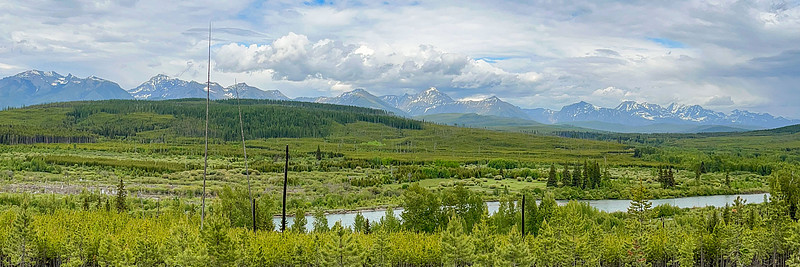
“The North Fork” is a reference to the North Fork of the Flathead River, one of 2 major tributaries to the Flathead River that border Glacier National Park. The Middle Fork of the Flathead River runs along the southern boundary and the North Fork borders the western boundary.
The North Fork also refers to the lands surrounding the entirety of the North Fork of the Flathead River, from Columbia Falls north to the Canadian border. Here one may find scattered private inholdings, some bordering Glacier National Park; others bordering the Flathead National Forest west of the river. But most of the land is either National Forest or National Park. The road in, the North Fork Road, is rough and long; a mix of pavement and long stretches of rock and gravel riddled with potholes and washboard. Copious amounts of dust are kicked up in dry weather, while the roughness of the road tests the durability of your shock absorbers and tires. If you want to get away from the crowds along Going to the Sun Road, this is an option, but be aware of its challenges.
After two weeks at Apgar Campground I was ready to head up the North Fork for my first true boondocking experience (one heads “up” or “down” the north fork as one follows the flow of the river). My choice to boondock was motivated by three things: saving money, the desire to start exploring the Flathead National Forest, and testing my abilities and affinity for being off-grid in a remote location. By the way, if you are wondering what “boondocking” is, it is a term used to describe RV camping where you can legally stay in your RV on federal or other land for free, but for a limited time and usually in a remote location where there are no hook-ups (water, electricity, sewer...).
With the peak season for camping at Glacier having arrived, prices at all the RV resorts outside the park had shot up, costing more than my old mortgage for a month’s stay. A month of free boondocking would help keep me in my allowances for campsites before I traveled to the east side of the park where I would again be paying for a site.
Before heading up the North Fork I took several days to drive around the Flathead NF to explore potential boondocking sites. The first site I found was an eye-opener. I traveled a Forest Service road outside Martin City, several miles west of Glacier (not up the North Fork). Martin City itself looked rather sketchy, but I was hopeful to find something in the National Forest along the Hungry Horse Reservoir.
Down a dirt side road I bumped and jostled for about a mile before coming out into an opening that sloped down to the water’s edge. On the uphill side to my left, three older model travel trailers lined the edge of the forest. To my right the steep hill leading down to the edge of the reservoir was nothing but dirt. All vegetation had been worn away by vehicles. Even though Forest Service regulations limit stays to 14 to 16 days, all three trailers looked like they had been there for years. All were as dirty and beat-up as could be. Worn out tarps covered the roofs, windows without screens or glass were covered with cardboard. Filthy plastic children’s toys, looking abandoned, were scattered about. I would have thought all these trailers were also abandoned except that one had a pick-up truck and dirt bike parked next to it that looked to be functional.
I made a U-turn and left as quickly as possible. This was not a good start.
Abandoning this area of the Flathead NF, I began looking up the North Fork. In addition to safety, sunlight was a top priority. At Apgar Campground I had watched the charge in my solar powered battery dwindle over the course of my 2 weeks there. My panels were getting only about 6 hours of sunlight each day and that just wasn’t keeping up with my use. I decided my next site needed to supply sun for around 9-10 hours a day.
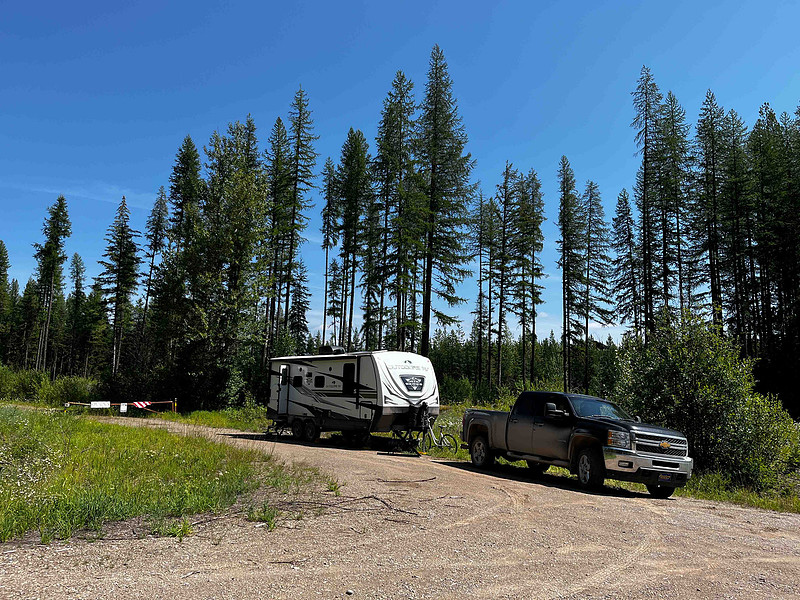
It took a few days and looking up several roads before I found a few sites that were more open and suitable for my rig. I settled on a site just off a main forest road (all one lane gravel and dirt roads): a side road with a gated and locked entrance. There was plenty of sunlight and enough room to ensure I would meet the restriction I’d read online asking that no gates or roads be blocked.
After I set up my RV, I took an evening drive up the main road to see who my neighbors were. About a mile back down the road I had one neighbor in an RV in a very shaded site. Just ½ mile past my site was a man camping solo with a tent and a small sedan. Driving further up the road about 5 miles, I found no one. There were only a few short side roads with no occupants.
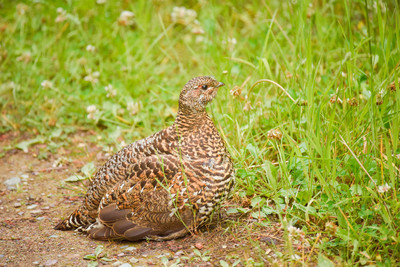
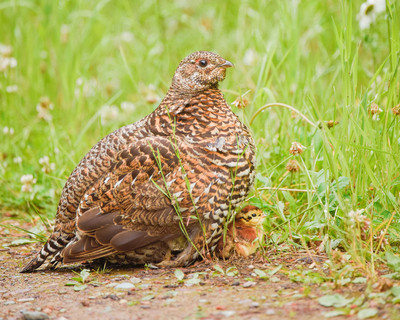
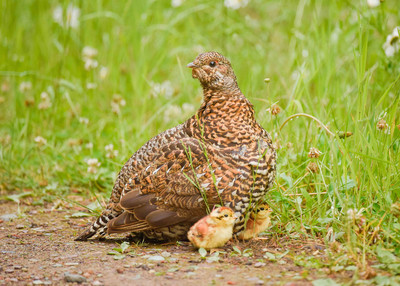
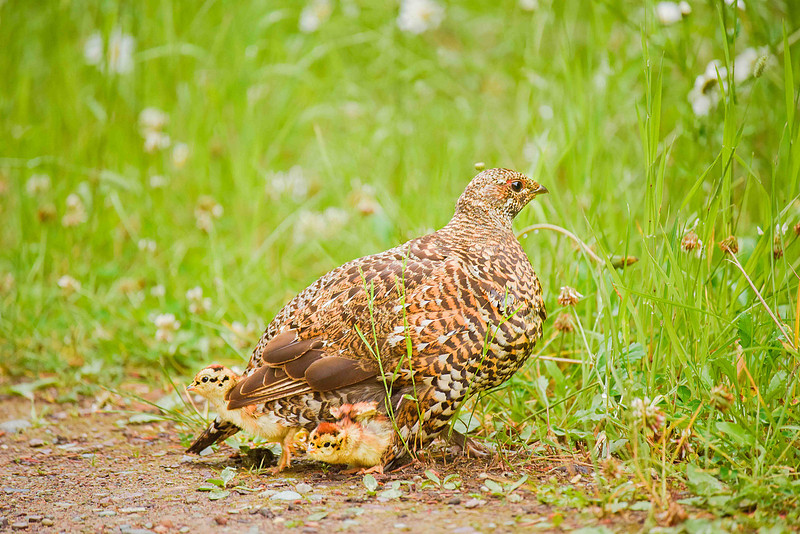
Driving back to my RV I did have a delightful encounter with one neighbor I hadn’t seen on the drive up: a spruce grouse.
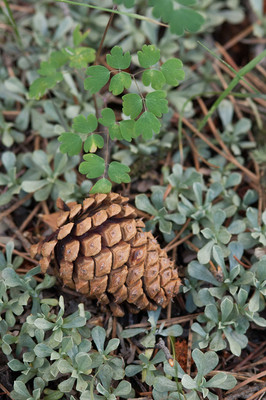
I had my camera with me so I got out and started shooting using my truck as a blind. Knowing that spruce grouse tend to be unafraid of people, I came into the open. She still didn’t move. I slowly got closer as I spoke to her softly. The pattern of her feathers around her neck caught my attention. It struck me that they replicated the patterns of scales on the cone of conifers like pines and firs, common trees in her habitat. How wonderful is God’s design, giving her camouflage for when she perches in the many pine trees in this forest. How beautiful.
Then I noticed the posture of her wings – held low, down to the ground. That got me even more excited. I continued to approach slowly until I was in a good range for my camera, then I sat down. She kept her eyes on me but didn’t move.
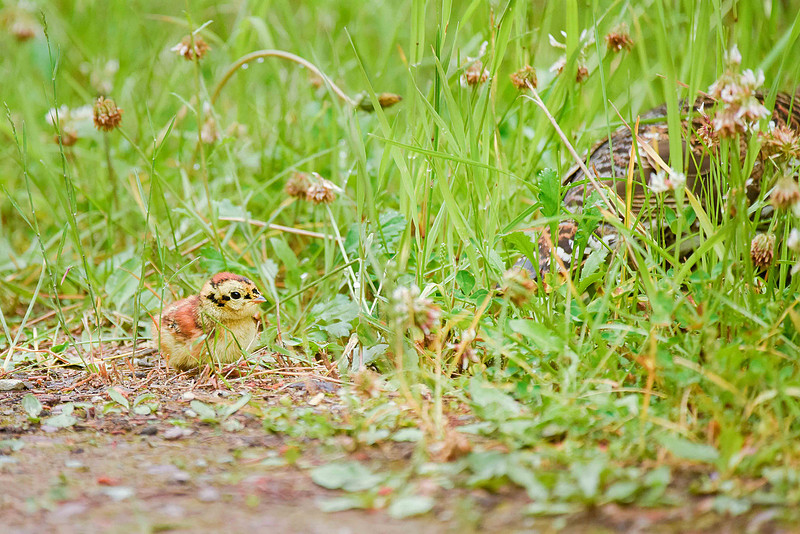
After a few minutes she became a little more animated, perking up her head and looking at me from different angles. Then the reasons for her wings being held low made themselves apparent. Two tiny chicks emerged from the warmth of her feathers. They were beyond adorable. Being very young they stayed near her until she decided it was time to leave, for the evening was getting on.
Slowly she walked off, letting out quiet clucking sounds calling her chicks to follow through the grasses and into the darkening woods.
All photos, videos and text are Copyright ©Julia Flanagan unless otherwise noted. All rights reserved.
Next Up: The North Fork, Part 2: Pollinators & Invasives
|