Travel Blog: St. Marks National Wildlife Refuge
St. Marks National Wildlife Refuge
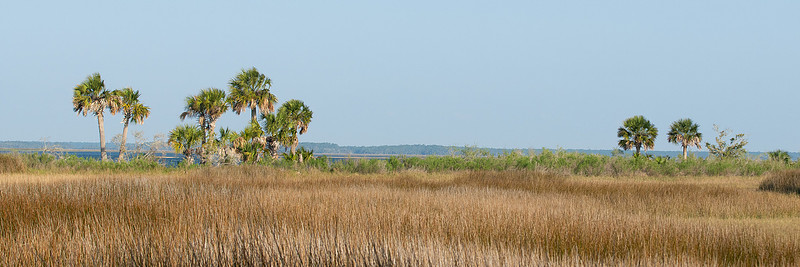
Despite the Earth's course around the Sun having brought the northern hemisphere into spring and the start of a new growing season, Florida was parched. April is the tail end of this subtropical climate's dry season and dry it was.
St. Marks NWR is quite large, spanning over 86,000 acres of the Florida Panhandle, including 17,000 acres of designated Wilderness and 43 miles of the Gulf Coast. In the 9 days I spent there from late March into early April, I would barely scratch the surface of places to explore.
Much of what I did learn was thanks to my friend, Karen, putting me in touch with David, a local photographer and nature enthusiast who is especially enamored with the sky's transitions from day into night (and vice versa) and the movement of the night sky, all of which he captures with time-lapse photography. David graciously took an afternoon to show me around and clue me into things like keeping my eye out for the beloved neighborhood Bobcat, where to find Osprey and Bald Eagle nests and more. (I did get a glimpse of the Bobcat, but only enough to get a blurry shot of his bobbed tail scurrying into the brush.)
David also gave me a breakdown of the various trails available to explore. Most of the dikes are walkable with little vegetation to obscure good views into the various impoundments. Such views seem to be deliberately maintained. While I was there, I watched a backhoe operator rip up shoreline vegetation. It may have been to keep a culvert clear, but it seemed more designed to keep views into the ponds open along the main road.
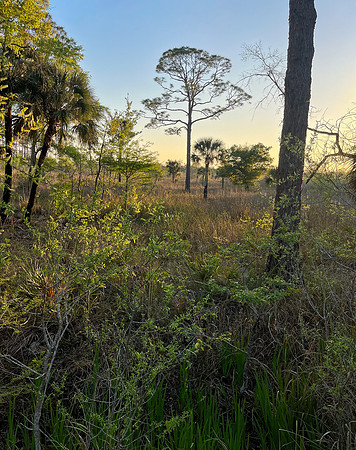
The Florida National Scenic Trail runs for dozens of miles through the refuge, traversing the varied terrain of open land, including pine savannahs, to cypress swamps and pine dominated forests. I must admit that coming recently from winter in Virginia, after an hour or two in the full sun of the dikes, I found myself eyeing the forests as my own refuge. Some days, the 75°F temperatures in unrelenting sunlight actually felt a bit oppressive. And, although the bugs weren't horrible, bug spray was a must almost every day, until a stiff breeze arrived and gave noticeable relief.
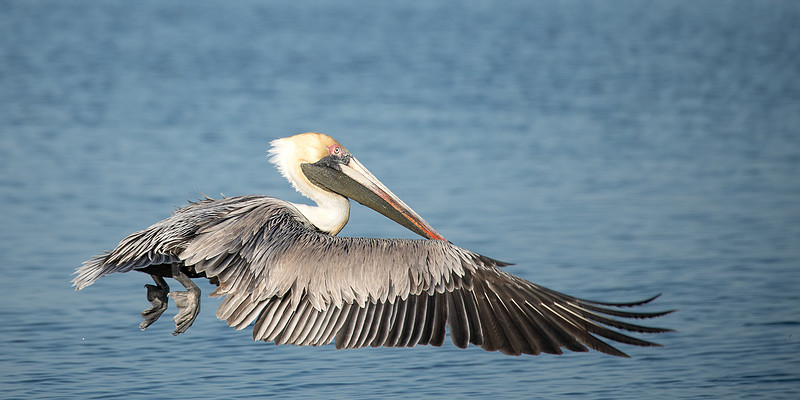
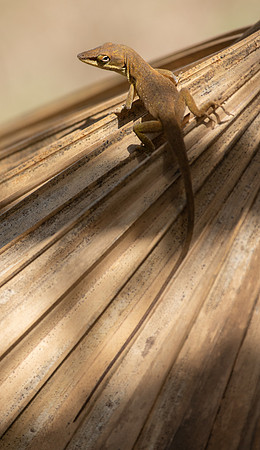
I explored the main road as well as several dikes and hiking paths. Open pools afforded good opportunities for viewing a variety of waterfowl, wading birds and shorebirds. The Headquarters Pool seemed the most popular spot for wading birds, perhaps because so much else was so dry. Spoonbills, White and Glossy Ibis, Common Moorhens, Great, Tri-color and Snowy Egrets hung out there - though too far back for photography. My movements along a small stretch of shoreline revealed the largest gathering of Yellow-crowned Night Herons I'd ever seen. Perhaps 12 or so adults made a gradual exodus from the pines along the impoundment edge. Their flight by ones and twos seemed to reflect the same solitary nature I've perceived in their foraging. A cloud of White Pelicans, high and distant, drifted away to the north. Much closer to the sandy ground, a Green Anole scampered off a living palmetto frond onto a dead one and then allowed me to get close enough to watch him change his disguise.
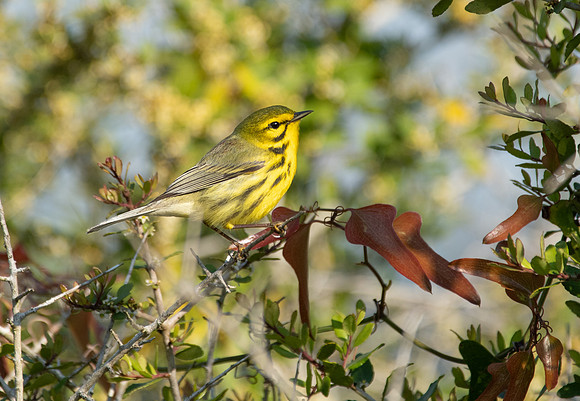
One morning I took a stroll down a narrow shrubby path near the lighthouse hoping to find some early migrant warblers. My logic was that this short and narrow spit of woody vegetation was so close to the coast that it might be a fall-out area for exhausted songbirds just landing from their trans-gulf flight. It was very quiet. The only new arrival was a Prairie Warbler, whom I was delighted to see. As is true of many migrants, he paid more attention to the bugs he was chasing than to me.
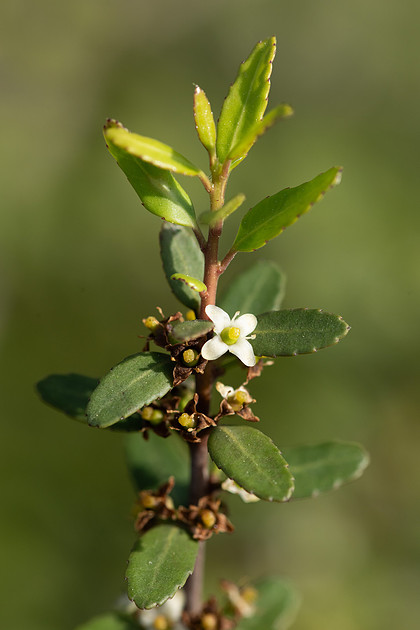
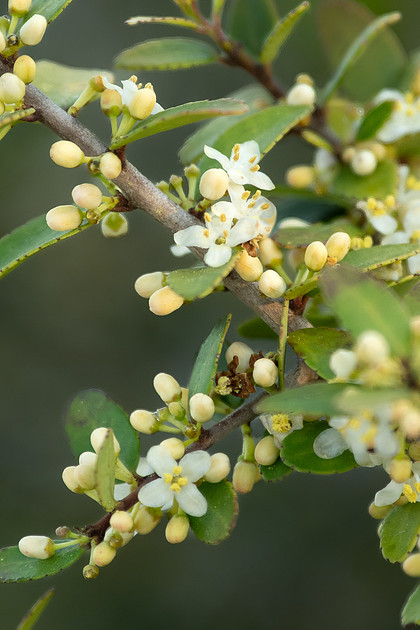
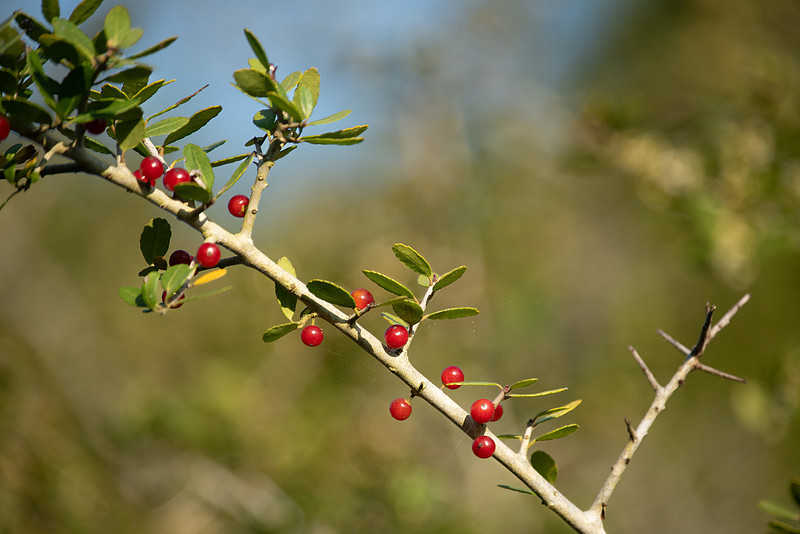
With the birds being few, I focused on the plants. The natural range of Yaupon Holly (Ilex vomitoria) barely makes it north into coastal Virginia. Here it was among the most common of shrubs. Yaupon showed off one of its traits that makes it desirable in a garden: some of the female shrubs were still holding their bright red fruit from winter. I have read that the twigs and leaves are used to make a tea that is naturally caffeinated and has antioxidants.1 Despite its specific name, the Lady Bird Johnson Wildflower Center indicates it has no emetic properties.2
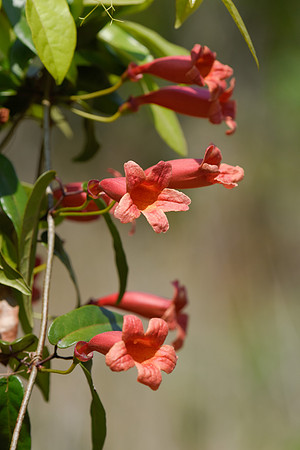
Crossvine (Bignonia capreolata), an evergreen climber,
At times my visit to St. Marks was frustrating: having to coat myself in bug spray, the energy draining effect of the strong sunlight, finding so many beautiful birds outside the reach of my lens, their wariness thwarting my every approach, apparently being too early to catch a wave of warblers arriving from the south. I have to remind myself that every new location typically starts with a learning curve, and reconnaissance demands both time and patience.
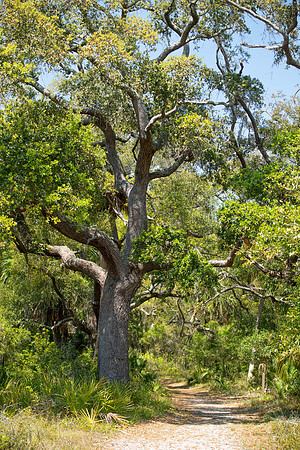
Relief from these frustrations often occurred when I stopped by the Visitor Center before heading home. Across from the Visitor Center parking lot stood two magnificent Live Oaks dripping with Spanish Moss. In the golden light of evening this little bit of sanctuary resonated with vespers that descended between the swaying Spanish Moss and from the surrounding forests. The chorus of prayers were sung by a Red-eyed Vireo, with his random Robin-like warble, a Cardinal determined to be heard, a Northern Parula, his soft voice rising in a trill just audible between the insistent petitions of the Carolina Wren. And farther away, the lovely kwirrr of a Red-bellied Woodpecker, a personal favorite. Their songs amid the cooling air and swaying moss drew me to the oaks where my whole being breathed in and let their voices pull me into the goodness of our Creator.
NOTES: 1. Yaupon Holly Tea. UF/IFAS Extension, University of Florida, Institute of Food and Agricultural Sciences. https://gardeningsolutions.ifas.ufl.edu/ 2. Lady Bird Johnson Wildflower Center. https://www.wildflower.org/plants/result.php?id_plant=ILVO
Up Next: Great Horned Owlets
All photos, videos and text are Copyright ©Julia Flanagan unless otherwise noted. All rights reserved.
Keywords:
alligator,
Florida Softshell Turtle,
Julia Flanagan,
Monarch Butterfly,
New Earth Photo,
Pelican,
Pine,
Prairie Warbler,
savannah,
St. Marks National Wildlife Refuge,
St. Marks NWR
Comments
No comments posted.
Loading...
|