Bringing Henry Home
Bringing Henry Home
This is a true story about Henry, a little caterpillar who was not particularly beautiful or special. When our paths just happened to cross one fine spring day, Henry opened an avenue for me to better understand how he navigates this world, his place in it, and especially where he calls home.
And there he was not – home that is. In fact, he was far from home. Although I didn’t know that yet, Henry knew it and that made him very restless. Meeting Henry ultimately led to my first success at helping an animal in need.
It’s not that I hadn’t tried to help animals before. I’ve had several opportunities to help bumble bees, wild geese, young racoons, baby rabbits, etc., each in need of human assistance. Yet I had never succeeded at actually helping them. Sometimes I didn’t know how to begin. Sometimes what I thought would be helpful proved harmful. Sometimes the animal was injured so badly there was nothing I, or anyone, could have done. Over time the sadness that resulted from my ineffectiveness made me reluctant to even try.
The afternoon I met Henry, I was in the middle of a one-day seminar on oaks. The morning portion of the seminar was spent indoors and brought the latest insights into Oak Decline. The afternoon portion took us to Conway Robinson State Forest where the leaders guided us to different stations demonstrating tools used in the field to treat mature trees. To reach each teaching station, our group of 30 or so attendees tromped through an oak glade with a layer of grasses and woodland sunflowers at our feet.
Henry appeared to be an unwilling participant in the seminar. I was among the stragglers making my way to the second teaching station, when I spotted Henry rapidly crawling along a tall blade of grass. Somehow, he had avoided being trampled to death by everyone in front of me.
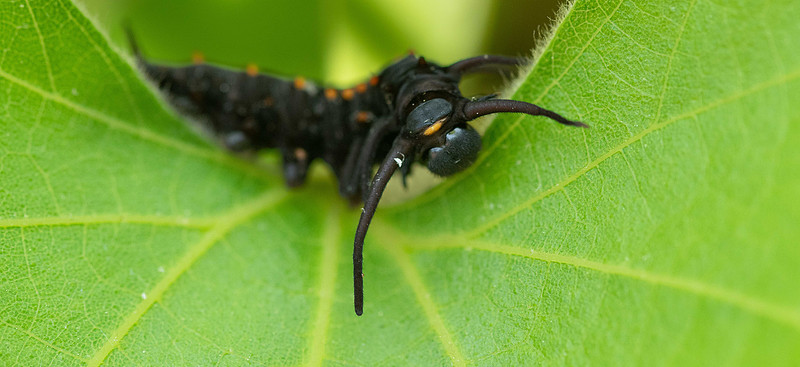
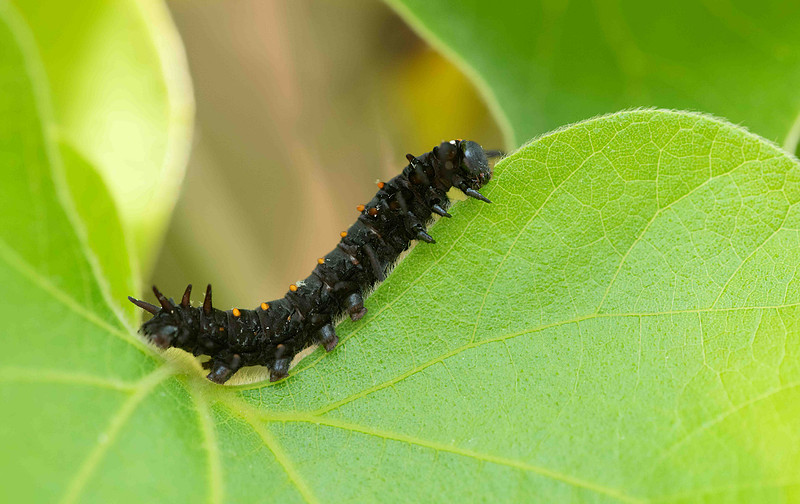
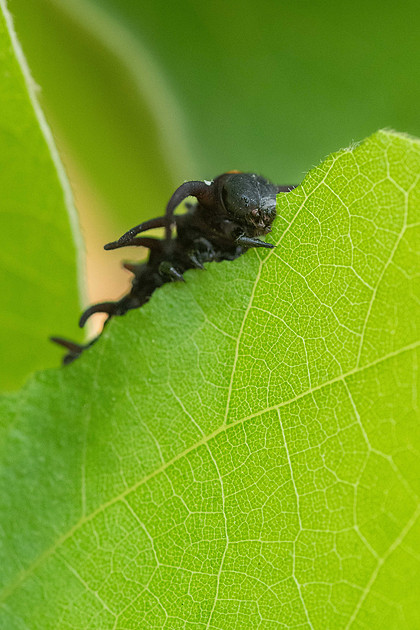
He attracted my attention because of the contrast of his black body against the green of the grass. His body was entirely black, top to bottom, head to rump, except for two lines of small, raised orange dots down his back. He also had several odd, floppy, horn-like projections with the largest ones by his head. The projections made me think of a court jester’s hat. As I mentioned, he was not particularly beautiful. Although I had never seen a caterpillar like him before, I could clearly see he was in peril: death by squashing.
When I reached down and picked the blade of grass he was on to inspect him more closely1, my friends Karen and Nancy joined in wondering what he was. Henry’s rapid crawling did not cease. He seemed to be marching with purpose. Before he marched himself off the blade of grass, Nancy, quick with her phone, had taken his image and submitted it to iNaturalist.
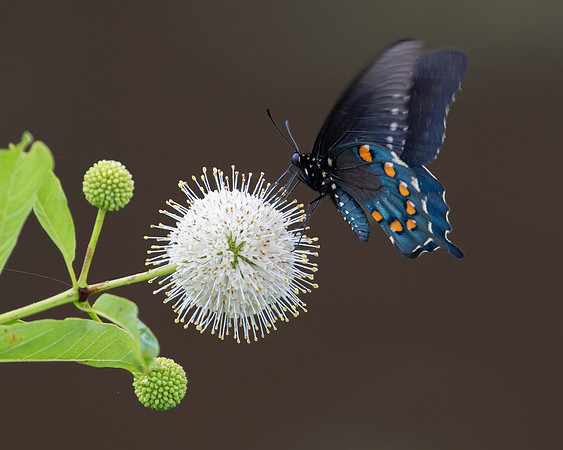
“Pipevine Swallowtail, Battus philenor” was the response. Indeed, he matched the description perfectly, court jester’s hat and all. My interest in him grew once we knew what he was. I had seen the adult Pipevine Swallowtail, but never the larva. It is (imho) among the most beautiful of our butterflies. But then, I’m really drawn to blues, and blues fading into black even better.
We were all concerned for Henry’s welfare as the possibility of him being trampled was high if we left him where we found him. We decided to find one of his host plants nearby, hopefully away from the crowd. iNaturalist noted the names of Henry’s host plants. A “host plant” is a species of plant that a particular species of insect larvae can eat without getting sick or dying. The list was short and made us realized Henry had another looming threat to his life. He was a specialist feeder. If we were to truly help him we couldn’t just set him on any plant. We had to find the right plant and there were only two species in our region that he could eat.
Pipevine Swallowtail larvae are like many of our native species of caterpillars. They are adapted to feeding on a very limited set of plants, having developed the internal biotics and chemistry needed to digest the toxins of those plants without harm to themselves. But that specialized digestion also prevents them from eating other plant species with different chemistries.
Adaptation to a plant’s chemistry is needed because plants have been given defenses too. Obviously, plants can’t run away from all the things that want to eat them. (Well, there is the Walking Fern, but it walks so very slowly it couldn’t outpace a sloth.) So, to protect themselves from being eaten by every herbivore in the neighborhood, plants manufacture toxic or distasteful chemicals, then locate those chemicals in their leaves, twigs, roots, etc. It’s a sensible and thoughtfully caring design. One bite and most herbivores will push that plate of toxic greens away with a hearty, no thank you.
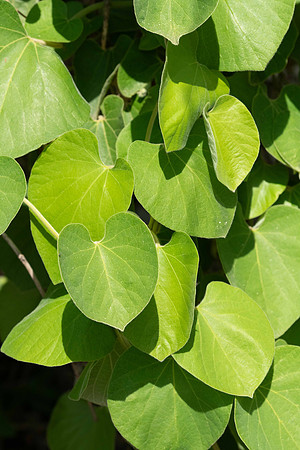
Many of the caterpillars that are adapted to eating toxic plants also have the ability to incorporate those poisons into their own bodies. Then whatever tries to eat that caterpillar will get sick from the stored toxins. Henry, I learned, is a lot like the famous Monarch Butterfly larvae which feeds only on Milkweeds (Asclepias sp.), which make Monarch caterpillars toxic. In Henry’s case, he could only feed on plants in the genus Aristolochia. Plants in the genus Aristolochia contain the toxin aristolochic acid. In our region, there are only 2 species of Aristolochia: Virginia Snakeroot (Aristolochia serpentaria) and Dutchman’s Pipe or Pipevine (A. macrophylla). Pipevine is where Henry gets his common name.2
We moved away from the other seminar participants, trying not to be disruptive. It was imperative that we find Henry’s host plant. Being already familiar with the arboricultural tools being demonstrated, I knew the remainder of my day had gained a new purpose.
Though we made a thorough search for both Pipevine and Virginia Snakeroot, we did not find them growing anywhere in the area. As we searched, Henry moved constantly, crawling off the grass, then on our hands and arms and clothing. He was restless and I began to understand that he too was searching.
So, if neither host plant was nearby, how did Henry get to the middle of our field session in Conway Robinson State Forest?
And then I remembered! The owner of the office building where we started our seminar had designed the site to be pollinator friendly by planting many Virginia native plants around the building. There was a large Pipevine growing up a trellis on the back wall of the building by the parking lot. Henry must have somehow gotten onto a seminar attendee’s clothing and been transported to Conway Robinson for our field session where he was brushed off into the grasses. An unwilling participant indeed!
And now he needed to be returned home. We put Henry in a secure container in a shady spot. When the field session concluded, Karen and I drove back to the office building where Henry was freed from his container onto Karen’s hand. He remained in his very determined search mode, ceaselessly walking, a caterpillar on a mission. We moved him toward the large heart-shaped leaves of the tall vine climbing the building. Karen’s hands formed a makeshift conveyor belt giving him a new runway as he reached the end of one hand until his next platform was a leaf of Pipevine.
The change in Henry’s demeanor was immediate.
As soon as his legs were squarely on the Pipevine leaf, he stopped his march. His whole body began to quiver and the largest of the court jester’s horn-like protuberances went into double time sensory mode, flopping around rapidly and repeatedly touching the leaf.
In Nancy Lawson’s excellent book, Wildscapes3, she writes of the various senses animals use to navigate the world. Watching Henry was an in-person tutorial on some of her chapters in which she describes how butterflies (just one of her examples) are able to detect a food source from long distances by the chemical signatures of flowers carried on a breeze, and how caterpillars smell through small antennae located near their mouths, in effect “tasting” a leaf to see if it is edible before they ever take a bite. A wise adaptation to help them avoid biting into a toxic plant.
Did Henry’s floppy horns help him “taste” the Pipevine leaf? A study by I. Kandori, et. al.4, indicated these projections on Henry’s head did not act as a means of tasting the Pipevine. But watch in the video below for the excited way in which Henry moved and touched the Pipevine leaf surface with his floppy horns. That made me think perhaps Henry actually was using them to sample his host plant. Possibly waiving them around caught the scent of the leaf in the air. In any case, his body could not help but show his excitement as he realized he was home.
Once assured he was in the right place, he climbed to the upper edge of the large leaf and moved behind it. It seems, toxic or not, Henry didn’t want a passing songbird to see his big, black beautiful body and make a meal out of him. And, yes, Henry had grown more beautiful in my eyes the more I got to know him. A few moments later he reappeared at the upper edge of the leaf and began to feed.
Notes:
p.s. Ten or so years prior to meeting Henry, I probably would not have acted toward him as I did that day. I would have been concerned for his welfare. I might have picked him up and wondered what he was. I probably would have cared enough to move him out of harm’s way, probably placing him on the trunk of a nearby oak, thinking he had fallen out of its canopy, thinking I was helping him. But it’s safe to say that is as far as I would have gone.
By the time I met Henry, I had grown in my understanding of the relationship between pollinators and plants, especially caterpillars. Aided by authors and speakers who study the interrelationships of insects and plants, they have helped me make connections between native plants, the (often undervalued) insect world around us and creatures I have long appreciated – like birds. This new understanding, along with a little help from my friends, helped make my encounter with Henry successful in getting him home.
If you would like to grow in your stewardship of the creatures that live around you, here's A LINK to some resources that have helped me.
All photos, videos and text are Copyright ©Julia Flanagan unless otherwise noted. All rights reserved.
Keywords:
Aristolochia macrophylla,
caterpillar,
Host Plant,
importance of native plants,
Julia Flanagan,
larvae,
New Earth Photo,
Pipevine,
Pipevine Swallowtail Butterfly,
Pollinator,
specialist feeder
Comments
Lesley Mullery(non-registered)
The background info and music added to the anticipation that Henry was home at last! Thanks for sharing!
Beth Curtis(non-registered)
You are the true "Caterpillar Whisperer!". Great video, cool story!
No comments posted.
Loading...
|