Travel Blog: Tate's Hell State Forest & the Red-cockaded WoodpeckerTravel Blog: Tate's Hell State Forest and the Red-cockaded Woodpecker
One might wonder why visit a place called Tate's Hell. I must admit the name made me question how bad it might be. It is near the gulf coast of Florida, so perhaps in summer it is a kind of hell, unbearably hot and buggy. Apparently, a fellow named Tate got lost in there one summer and suffered greatly before finding his way out.
I, however, would arrive with spring. After a brief visit with my brother in Narrows, VA, I was skipping plans to travel to South Carolina to spend more time in Florida. Tate's Hell State Forest would be my first stop on my introduction to the Florida Panhandle. This change in plans would also mean fewer miles on Bubba Bear and would save money given the recent dramatic hike in diesel prices. So, how bad could it be in spring? Well, if the place lived up to its name... life could only get better from there.
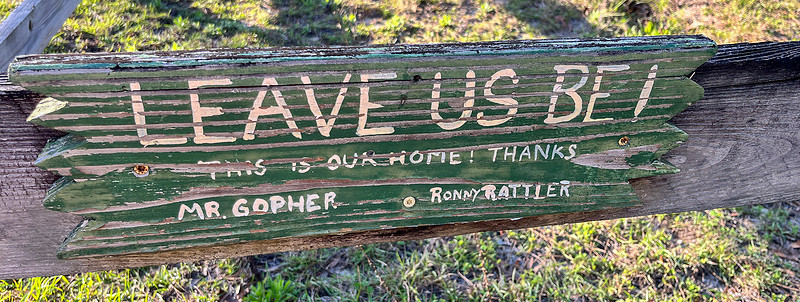
The campground had an interesting sign posted near the campground host's site asking visitors to be kind to two particular campground residents, one of which I hoped not to meet unexpectedly. I never saw the campground host to ask if Ronny was still around. Thankfully, I also didn't learn of his whereabouts by direct encounter.
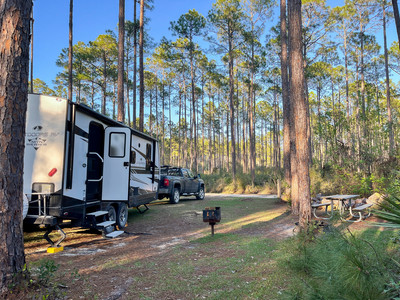
If you choose to stay at Womack Campground, I'd advise bringing your own water. Water availability is limited to a couple campsites. If someone is occupying the campsites with water, you may not be able to drive your rig in to fill up. Also, the available water is untested well water, which is why it is not labeled as potable. It does smell somewhat unpleasantly of sulfur. But I have drunk similar smelling water at other southern coastal sites that was labeled potable.
I've read the smell is from naturally occurring ground water bacteria that break down sulfur and give off a gas containing sulfur. Not pleasant to smell, but not harmful either. I wished that I had put sufficient fresh water in my tank before arriving, but I made do. There is no dumpsite in the campground.
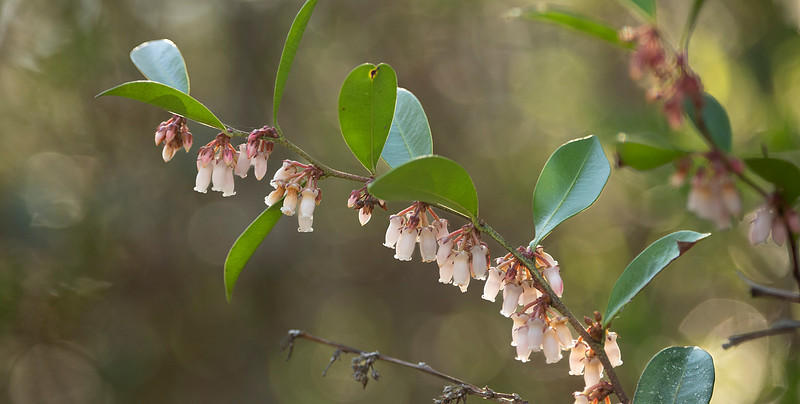
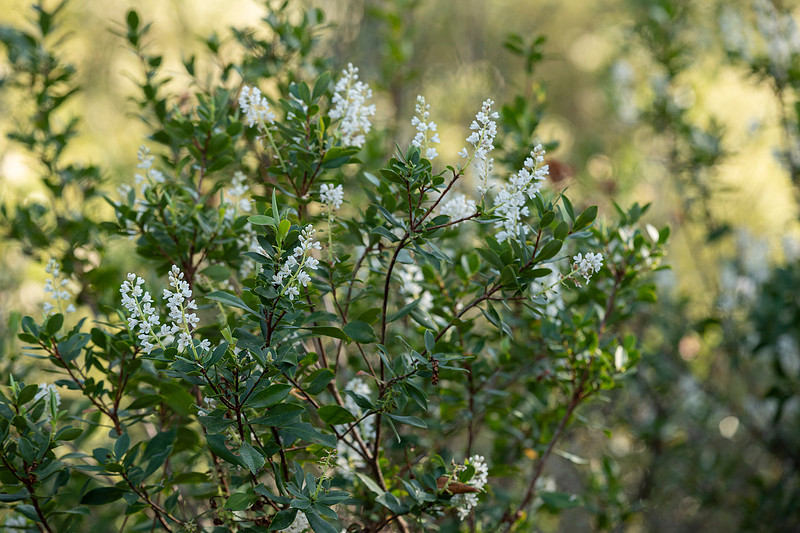
I arrived March 21st. Visiting in March beat the heat and humidity, and most of the mosquitos and other bugs that helped give Tate's Hell its name. Indeed, the weather was pleasant. Shorts were in order. On some days, bug spray was too. I found plants already in bloom: Sweet Azalea, Staggerbush, and some blueberries. Sweetgum and Black Cherry trees, species I had left behind in Virginia only a few days earlier with their buds still tightly closed, were already leafing out. Red Maple, leafless and blooming in Virginia, was blushing red with maturing samaras dangling high up while the leaves were nearly fully expanded.
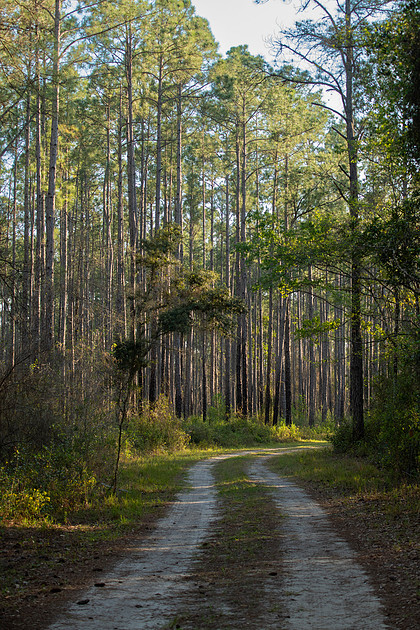
Being this far south, several plant species not found in Virginia are part of the natural ecology. A different set of southern pines create the forest canopies. Where I am familiar with the 5 or so pines native to northern Virginia, here several pines unfamiliar to me drew my curiosity. Shortleaf Pine is more common. Longleaf, Sand, Pond and Slash Pines are at home in this southern clime and absent from Northern Virginia. Having a background in forestry helped me get some of the other plants to their genus. Online research would help with the fine tuning. But I puzzled at many of the shrubs and smaller trees. Were they Bays, Leucothoes or southern Hollies? Their names remained a mystery, for now at least...
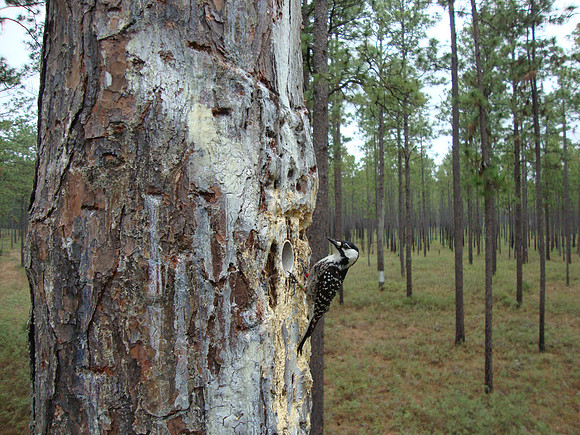
Another draw to this location was the hope of seeing and photographing the Red-cockaded Woodpecker (Picoides borealis). During my short visit, I was to have no success in even seeing this threatened woodpecker, though I did learn of several potential sites to explore in the future.
The Red-cockaded Woodpecker is a Federally Threatened species. It was originally listed as Endangered due to loss of habitat. It has fairly specialized habitat requirements, utilizing almost exclusively mature pine forests and preferring Longleaf Pine (Pinus palustris), in order to nest. Over the past hundred years and more, timber harvesting cleared mature Longleaf Pine forests, often replacing them with farm land or creating monocultures of short-rotation pine plantations that would be harvested before the trees ever reached the sizes needed for nesting. By the 1970's only 3% of the historic range of the Longleaf Pine ecosystem was left. Populations of the Red-cockaded woodpecker reflected the loss.
For nesting, this woodpecker also prefers pines infected with a fungus (Porodaedalea pini) that causes Red Heart Disease. The disease only infests the heartwood of live,
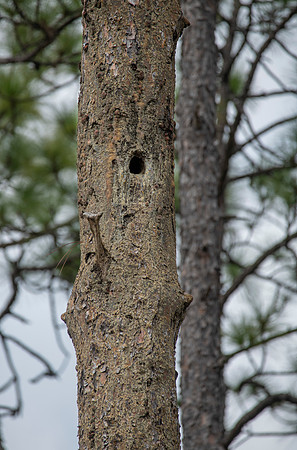
Downlisting to Federally Threatened status occurred in 2024. Extensive efforts over 50 years to aid the bird’s recovery included the use of artificial nesting cavity inserts and re-establishing mature Longleaf Pine forests maintained through fire (more on Longleaf Pines and fire ecology in a future blog). Partnerships between public land-owning agencies, conservation groups and private land owners has been instrumental in seeing the Red-cockaded Woodpecker recover. I'm particularly intrigued and excited by private landowners who choose to restore the Longleaf Pine ecosystem on their land at least in part due to their interest in helping this threatened bird succeed. Makes me wish I had a thousand acres to do the same. I was able to explore a Longleaf Pine stand with tell-tale signs of Red-cockaded Woodpeckers having nested there in the past. As a defense against predators such as snakes, the woodpecker, often the young males from the most recent generation of the family group, maintain sap holes above and below the nesting hole. Sap from the pines coats the tree trunks, helping discourage would-be predators from approaching via the trunk. I found pines with sap coating their trunks above and below old nesting holes indicated a family group had a nest there recently, but not this season. The hole entrances looked unused, the sap was not fresh and had not been roughed up by recent comings or goings. Lord willing, I will be able to hunt (with a camera, that is) this rare woodpecker next winter. For now, reconnaissance seemed the measure of success.
I'm not sure if I would utilize Womack Campground again. If I do, I will bring my own water, and perhaps a kayak. Returning to explore these ecosystems more, is definitely on my wish list.
NOTES: 1. U.S. Fish & Wildlife Service, Species Information. https://www.fws.gov/species/red-cockaded-woodpecker-dryobates-borealis Other helpful links to the Red-cockaded Woodpecker: A Nature Conservancy article on restoration efforts: https://www.nature.org/en-us/about-us/where-we-work/united-states/north-carolina/stories-in-north-carolina/red-cockaded-woodpecker-military-conservation/#:~:text=Why%20is%20the%20red%2Dcockaded,management%20benefits%20the%20whole%20forest Cornell Birds Life History: https://www.allaboutbirds.org/guide/Red-cockaded_Woodpecker/lifehistory
NEXT UP: Bald Point State Park, Florida
All photos, videos and text are Copyright ©Julia Flanagan unless otherwise noted. All rights reserved.
Keywords:
camping,
conservation,
Julia Flanagan,
Lorax,
new Earth Photo,
Red-cockaded,
Tate's Hell,
travel,
Womack,
Womack Campground,
woodpecker
Comments
No comments posted.
Loading...
|