I hate computers. I was going to start this by writing, “I love computers. I hate computers” but a book I read on nature writing admonished me always to be honest. Since I’ve spent way too much of the day trying to figure out where 5 days worth of images that I uploaded to Lightroom weeks ago have disappeared to, and hours later I still don’t know, he opening sentence will do. Hrumph!
Time to do something refreshing. Time to take a walk.
I just moved to a campground on the Blackfeet Reservation just east of Glacier National Park. My RV is nestled next to a lovely and broad stand of quaking aspen that separates me from a lake. Morning sun, afternoon shade. Perfect for warm summer days. I had spent a day at this campground earlier this summer on one of my loon surveys during which I observed and documented 3 loons at the northern end of the lake. I headed there for my walk in the hopes of spotting loons again.
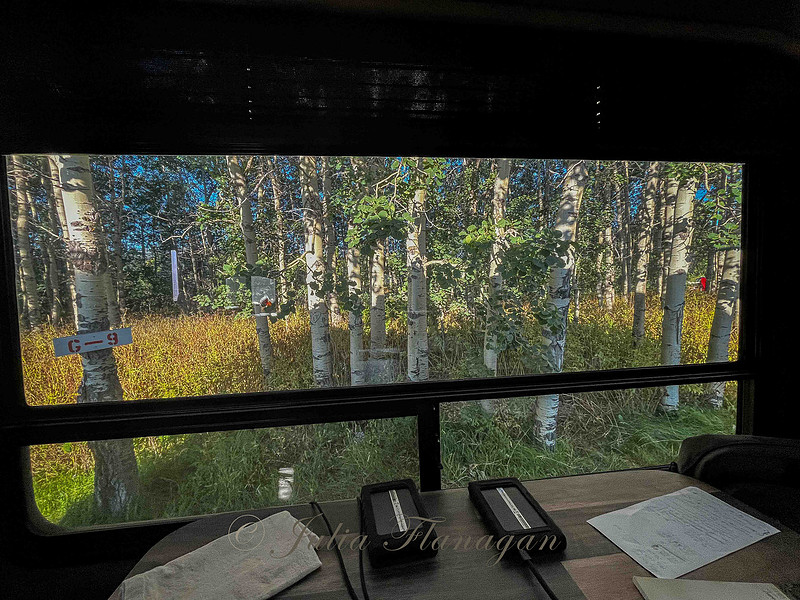 Quaking Aspens make for an absolutely lovely view from my dining table.
It is a beautiful evening, the sun is edging its way down toward the western mountains, a light breeze carries warm dry air. The mosquitos that had been rather pesky in June and July on the west side are absent. It’s quiet. Not a lot of campers here. A woman lounges by her RV reading a newspaper. I find a footpath by an empty campsite and descend to the shore.
I like this campground. The owners have left a wide swath of native vegetation along the shoreline. All campsites, even those marketed as “waterfront”, are well separated from the water. I appreciate the many ecological benefits to such a buffer, as compared to clearing to the water’s edge. There’s little life when the native plants are stripped away. Where I stand, red-twig dogwoods, the same species of shrub we have in Virginia, create a thicket on both sides of me. Many willows are in the thicket along with alders. I scan this small portion of the lake with my binoculars – no loons. Across the cove a yellow warbler scuffles with an interloping flycatcher. I'm the interloper along this stretch of shore. A house wren scolds me from a shrub nearby. On my other side I hear the mewing complaint of a catbird. I've interrupted their peace.
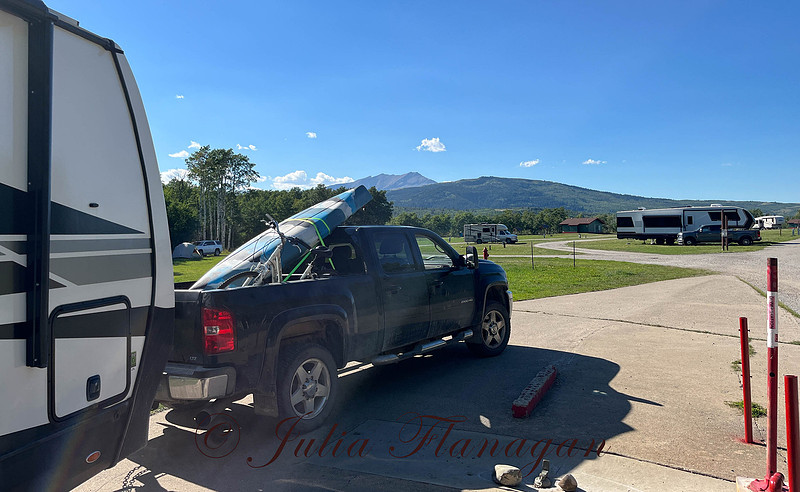 Bubba Bear enters my campground on the Blackfeet Reservation.
I make another sweep; the loons may have been underwater. I spot a dark brown, wedge-shaped head at the surface. A beaver is swimming toward me. Right toward me. He’s a couple hundred feet out. Perhaps he doesn’t see me, they do have poor eyesight. He keeps coming. Ugh! – I left my camera at my RV. I pull out my iPhone and start to record video of him. When he gets about 70’ away he makes a slight adjustment, now tracking to land just west of me. As he nears shore he loops, submerges, comes back up, looks me in the eye, loops again, then swims ashore not 15’ away, immediately disappearing into the brush.
Bubba Bear enters my campground on the Blackfeet Reservation.
I make another sweep; the loons may have been underwater. I spot a dark brown, wedge-shaped head at the surface. A beaver is swimming toward me. Right toward me. He’s a couple hundred feet out. Perhaps he doesn’t see me, they do have poor eyesight. He keeps coming. Ugh! – I left my camera at my RV. I pull out my iPhone and start to record video of him. When he gets about 70’ away he makes a slight adjustment, now tracking to land just west of me. As he nears shore he loops, submerges, comes back up, looks me in the eye, loops again, then swims ashore not 15’ away, immediately disappearing into the brush.
I think of how close he is. With excitement I think, "This should make a good recording! I barely even needed to use the zoom feature." I go to push the “stop button” to end recording and instead hear the phone make its fakey shutter clicking sound. I just took a picture. I took a picture? I’m not in video mode? I’m not in video mode. I was never in video mode. My head hangs. This beautiful animal is RIGHT HERE! Ugh! Can I do nothing right with a computer or a camera today? I check my heart and remember to simply enjoy what God puts in front of me. And I switch to video mode.
The beaver pushes through the dense shrubs. I can only think that he wants to harvest some juicy, young willow branches which are in this spot in abundance. And this he does. He reappears at the shoreline with a couple fresh twigs in his mouth, their length trailing along his flank as he slips into the water. This is the time of year when beaver begin building up their winter larders.
In the cold winter climate of Montana, beavers build up underwater caches composed of the woody twigs they harvest in late summer and fall. To make the cache, beavers will create a muddy bank close to their lodge. Harvested twigs and branches are then jammed into bank or into the muddy bottom of the pond or lake making a sort of underwater forest. Once the lake or pond they live on freezes over their access to above ground food sources is greatly limited. But their cache will provide them with fresh cambium and bark throughout winter. A beaver family (usually 4 to 10 beavers per lodge) will depend on what they have stored underwater to feed them until spring.
When I saw the beaver emerge with willow for his cache, I felt an affinity with him. As an urban forester I oversaw a variety of reforestation projects including reforesting stream banks. I often utilized several of the same species of trees and shrubs the beaver relies on. In my work we would take winter harvested twigs of willow, red-twig and silky dogwood and jam them into stream banks, the muddier the better. These species are among only a few woody plants that have the ability to root when the cut twigs are kept in constant contact with moist soil. We called this "Live Staking", an inexpensive means of revegetating stream corridors.
I suspect the beaver may play a similar role in revegetating stream and lakes. That they are like an aquatic version of a squirrel who occasionally forgets where he buried an acorn and so fosters the regeneration of oaks. In God's economy, the squirrel both consumes and regenerates a species he relies upon. If some of these twigs in the beaver’s larder have access to sunlight and air and the beaver forgets about or simply doesn’t eat them, the beaver may very likely be propagating new colonies of willows, dogwoods and the like for the future.
Having collected willow twigs for his winter cache, Mr. Beaver heads back to press them into a muddy bank by his lodge.
So it was with a sense of appreciation, fondness and kinship that I watched this beaver swim back toward where he came with the same even pace of his approach, submerging occasionally then resurfacing, willow branches in tow until he submerged at the far shoreline under a tangled mass of dead limbs and my enjoyment of him came to a close.
All photos, videos and text are Copyright ©Julia Flanagan unless otherwise noted. All rights reserved.
