Travel Blog: Great Horned Owlets & Resurrection FernsGreat Horned Owlets & Resurrection Ferns
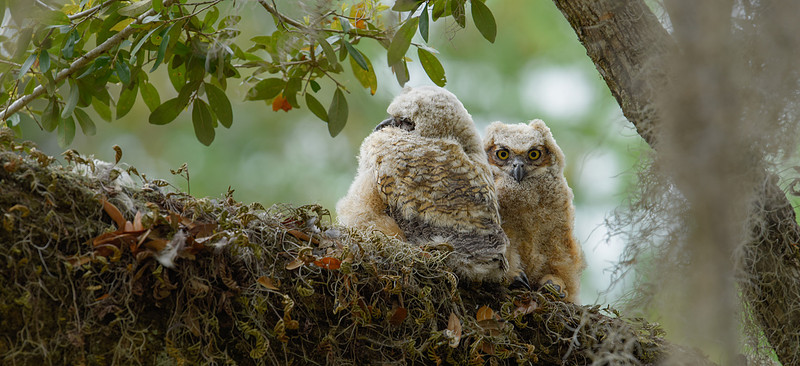
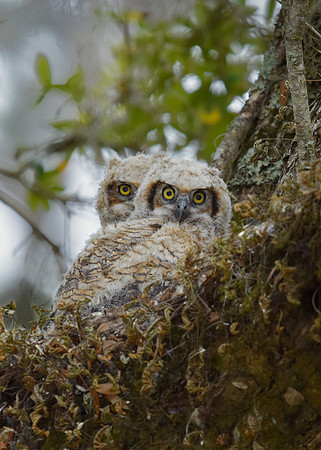
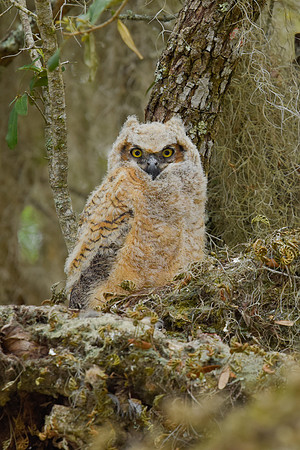
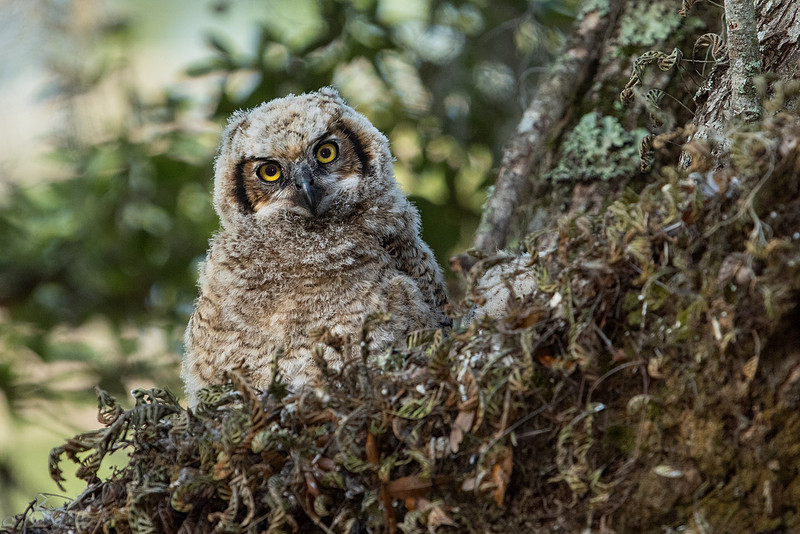
My time at St. Marks National Wildlife Refuge was almost a bust when it came to photographing birds, until I spotted nestling Great Horned Owls (Bubo virginianus). It is not often one finds an owl's nest. It's even more rare to find one that presents good opportunities for photography. I was thrilled to find these owlets in an open nest a mere 20' off the ground.
In 1890, Ernest T. Seton wrote of this species, "My ample opportunities of fully observing these interesting birds in captivity as well as in a state of freedom, and indeed all that I have seen of them - their untamable ferocity, ... their magnificent bearing; their objection to carrion, and strictly carnivorous tastes - would make me rank these winged tigers among the most pronounced and savage of the birds of prey."1
Indeed, their silent flight enables them to excel at tracking down all manner of prey: every small mammal you can think of including bats, domestic cats and rabbits, even those with excellent defenses like skunk (apparently they have a poor sense of smell) and porcupine; birds of many kinds from bitterns and other marsh birds, to waterfowl and domestic fowl, songbirds, even other raptors like Coopers, Red-tailed and Red-shouldered Hawks; also fish, frogs, snakes, eels and even insects.
This helps explain how their range spans nearly all of North America.
You can see in my images presented here that there seems to be nothing added to the almost horizontal branch. At first, I thought the nestlings had moved out of their nest. But after watching them over a couple days, I decided they were in their nest. It just didn't look like what I thought a nest should look like. Another good example of how taking the time to observe wildlife teaches cool things.
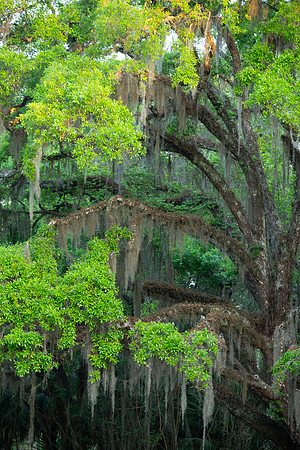
Speaking of cool things.... The shriveled greenery profusely covering the branch is a common epiphyte on Live Oaks (Quercus virginiana) called Resurrection Fern (Pleopeltis polypodioides). It is growing among another epiphyte, Spanish Moss. Epiphytes are plants that live on other plants for a supporting structure and are not rooted in soil. In the case of Resurrection Fern it is also a lithophyte, meaning it can live on rocks.
Both the leaves and the roots of Resurrection Fern can take up water on the surface of the tree bark and from the humidity in the air itself. In fact, if a fern is separated from its root, it can still absorb sufficient water from humid air to be lush and green. When the weather is dry, Resurrection Fern gradually dries out and shrivels up (like you see in my images). It can lose from 75% to 97% of the water in its cells while in a dormant state.3 It can remain in this desiccated state for years waiting for adequate rainfall or humidity to allow it to unfurl and begin photosynthesis and reproduction.
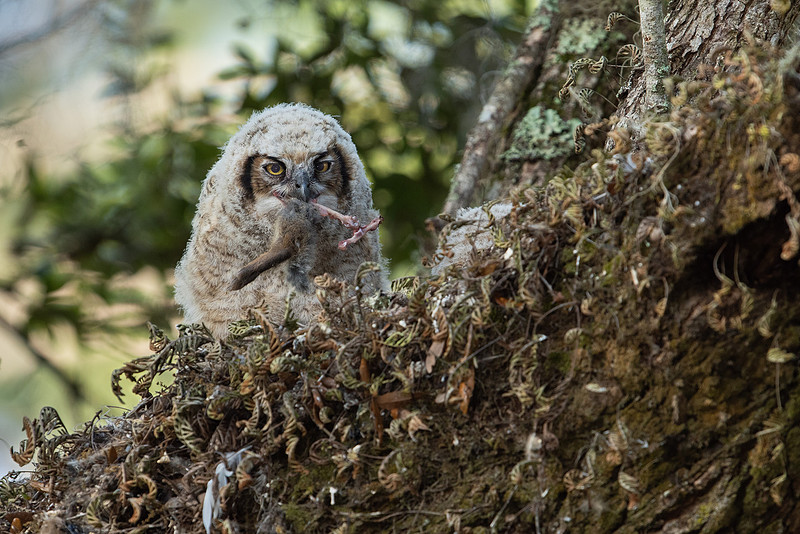
I hoped we would get rain during my visit in the area so I might witness this resurrection. Alas, this was not to be. Instead, the growing lives of young Great Horned Owls lay before me, predators extraordinaire. For this I was very thankful. During the three days I visited the owlets I only saw one parent, snoozing high in a nearby tree, and then only once. But their presence was apparent when one of the owlets began to partake of a meal - Rabbit Tartare.
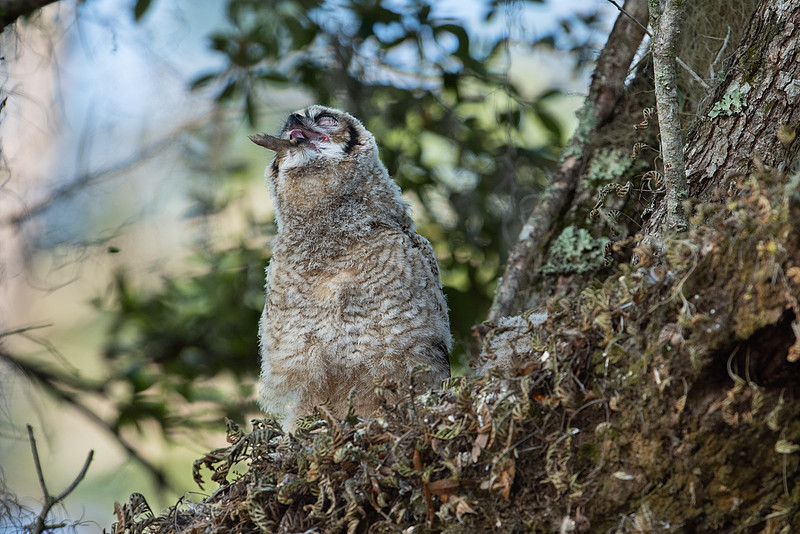
I presumed the meal had been delivered only hours before in the night. When I arrived, there was only part of a leg left. I watched one hungry owlet pick bits of meat off the bone and then attempt to swallow the remainder in its entirety. She had it worked almost completely down her gullet with her head held high and using several gulping motions until only some toes were left to fit in. Then she decided the whole thing it was a bit too much. Birds have no gag reflex like people do. So, the effort in and out was easy. She simply leaned over and let gravity help her spit it back out. Such is a youngster still figuring out her limitations. Perhaps at a later time she'd use her strong bill and talons to separate it into more manageable pieces.
It was an interesting juxtaposition, the owl dismembering the rabbit in a bed of ferns that speak of resurrection. Easter was only a few days away. I was looking forward to celebrating Resurrection Sunday with a local church. There is a lot to contemplate in the resurrection of Jesus. It speaks of many things. We may be absorbed by the unfailing love, perfection and power of Jesus, whom death could neither defeat nor hold in the grave. We may think of the glorious promise for us as both physical and spiritual beings, that all who repent and put their trust in Jesus Christ will partake with him in eternal life, experiencing redeemed bodies that will never again sin or suffer pain, disease or death. Just as wonderful, we may anticipate being reunited with loved ones who have gone on before us in faith.
My mind also moves to contemplate the implications of Christ's resurrection on the natural world. Isaiah 11:1-9, Romans 8:18-22 and Revelation 21:1-5 give us hope for this Earth, that God's intent is to bring new life to all he has made. That even as creatures now groan in futility because of our fallenness, all the creatures of this Earth will come into newness with us, through the redemption Jesus brings to us. They will be freed from the suffering they currently know when we are transformed to live in perfect accord with God's will.
In that day, we are promised the wolf will lay down with the lamb in peace.4 And so this "winged tiger", "among the most pronounced and savage of the birds of prey", will come to rest beside the rabbit, both enjoying the freedom of a new creation.
NOTES: 1. Bent, Arthur Cleveland. 1938. Life Histories of North American Birds of Prey (Part 2), Orders Falconiformes and Strigiformes. Bulletin of the United States Museum. No. 170. Pg. 295. 2. Schlesinger, W.H. and Marks, P.L. (1977), Mineral Cycling and the Niche of Spanish Moss, Tillandsia usneoides L. American Journal of Botany, 64: 1254-1262. https://doi.org/10.1002/j.1537-2197.1977.tb10819.x 3. Prats KA, Brodersen CR. Desiccation and rehydration dynamics in the epiphytic resurrection fern Pleopeltis polypodioides. Plant Physiol. 2021 Nov 3;187(3):1501-1518. doi: 10.1093/plphys/kiab361. PMID: 34618062; PMCID: PMC8566288. 4. Isaiah 11:6. The Holy Bible. 1984. New International Version.
Up Next: A Friendly Welcome at Gateway Trails RV Park
All photos, videos and text are Copyright ©Julia Flanagan unless otherwise noted. All rights reserved.
Keywords:
Bird of Prey,
Bubo virginianus,
Florida,
Great Horned Owl,
Live Oak,
nestling,
owlets,
Predator,
Predatory Bird,
refuge,
Resurrection Fern,
St. Marks NWR,
Wildlife,
young
Comments
No comments posted.
Loading...
|