Going to the Sun Road: The Rock Garden
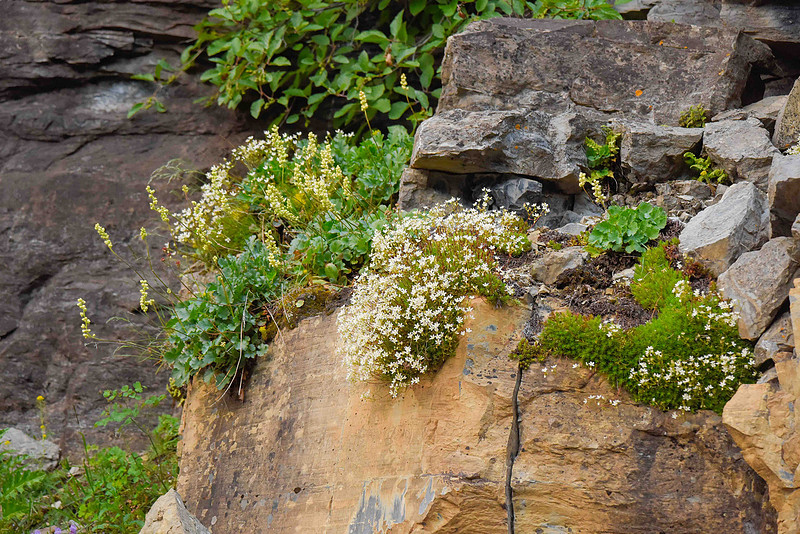 Spotted Saxifrage and Round-leaf Heuchera are just some of the beautiful wildflowers in the Rock Garden that is the higher elevations of Going to the Sun Road. Late spring/early summer are the best times to enjoy these sights.
Traveling the Going to the Sun Road (GTTS) is an experience in itself. Whether you are entering from the east or the west there are many interesting stops along the way. If you are just moving continuously through, it is about 50 miles and a 2 hour trip from one park entrance to the other. But there are ample reasons not to rush. I recommend you plan on taking your time and let the views, wildflowers, hiking opportunities and unexpected encounters with wildlife set your agenda.
One of the things I enjoy as I drive up GTTS is entering what may best be described as a rock garden. Rising above the forests of the lower elevations the builders of GTTS cut the road into the sedimentary bedrock of these mountains, leaving behind many rock outcrops and ledges. Over the decades pioneering wildflowers have recolonized the cuts for the road, gaining a foothold as each year’s plants die and are pressed flat by snow and ice. The small amount of organic matter each plant contributes gradually creates a thin layer of soil. Just enough for the next generation to make a go of it in the rains of spring and early summer, and then contribute a little more for the following growing season.
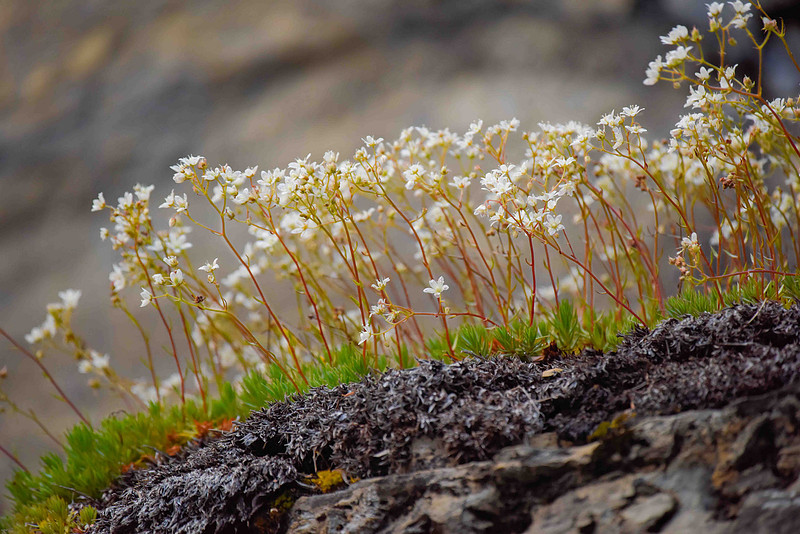 Spotted Saxifrage. Here you can see the thin black layer composed of the leaves, stems and roots of prior years plants. Very little decomposition has taken place due to several factors. One factor is that at high elevations the period when temperatures are warm enough for fungi, bacteria and other decomposing soil organisms to operate is short. This black layer helps us get an idea of just how little soil is available, how tough these plants are and how fragile is this environment.
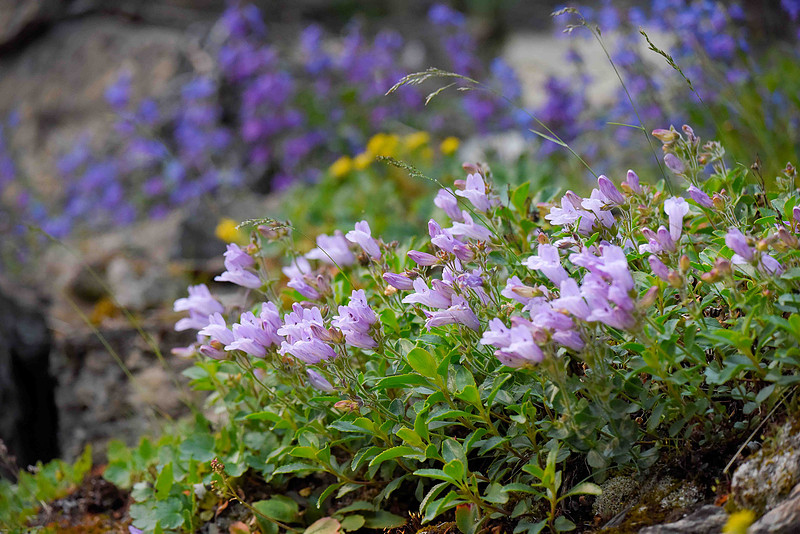 Pale lavender and rich blue Penstemons grow in thick low clumps that provide protection from wind and help hold moisture in what soil they have to root.
Montane species like Round-leaf Heuchera (Heuchera cylindrica), Penstemons and Saxifrage flow over ledges in cascades of blue and creamy white. Indian Paintbrush stands tall in punctuations of brilliant red. Spearleaf Stonecrop (Sedum lanceolatum) brings bright yellow accents and shows its toughness by keeping company with the lower montane species and plants further up in the subalpine habitats.
Pale lavender and rich blue Penstemons grow in thick low clumps that provide protection from wind and help hold moisture in what soil they have to root.
Montane species like Round-leaf Heuchera (Heuchera cylindrica), Penstemons and Saxifrage flow over ledges in cascades of blue and creamy white. Indian Paintbrush stands tall in punctuations of brilliant red. Spearleaf Stonecrop (Sedum lanceolatum) brings bright yellow accents and shows its toughness by keeping company with the lower montane species and plants further up in the subalpine habitats.
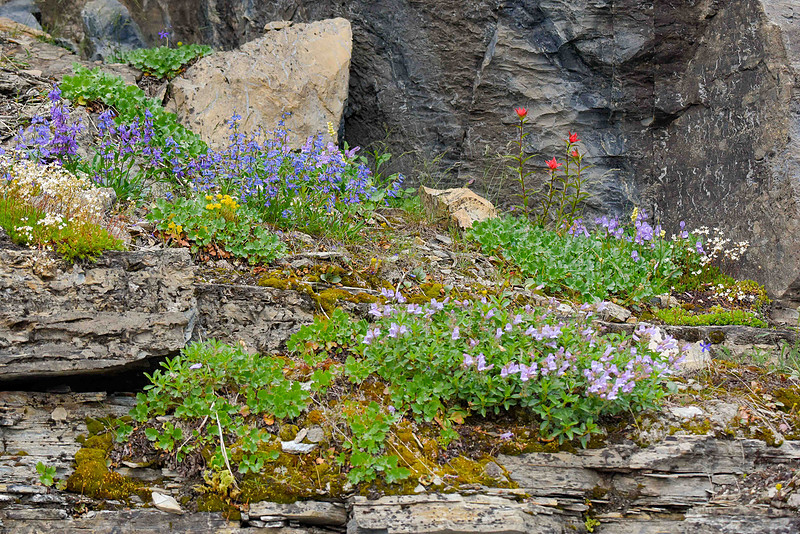 Hardy herbaceous perennials and mosses survive on very little soil as trees are now stunted and scattered and harsh conditions limit what will grow on exposed rocky slopes.
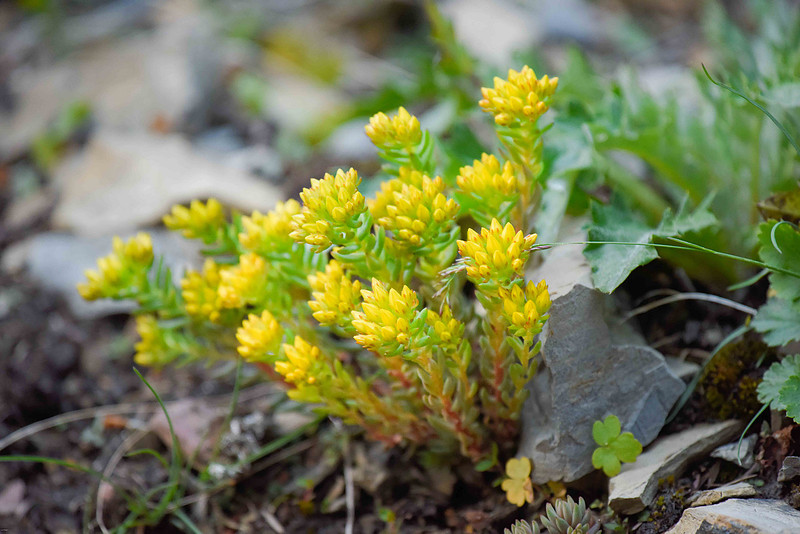 Spearleaf Stonecrop (Sedum lanceolatum) is a quintessential rock garden plant, tough and vibrant. Not just for the wild, it makes a great native plant for one's home.
A Word of Caution: Obey the traffic signs. No vehicles over 21’ in total length (car/truck/RV/trailer combined) are permitted beyond a certain point for very good reason. You don’t want to be like the folks I saw a couple years ago in a 40’ long Class A RV bus (that probably cost well over $200,000) who got hopelessly hung up on the rock wall at The Loop doing major damage to their axels and under carriage. Or the folks In a Class C Motorhome I was driving behind earlier this year. They may have been close to meeting the 21’ restriction and were driving very carefully. Nonetheless they ripped off a piece of their roof passing too close to a rock outcrop – of which there are many. Now that I own a bigger truck, I’ve made a practice of folding back the side view mirrors on Bubba Bear, my Chevy Silverado 2500, just so I have a little more room passing vehicles on the tight curves – of which there are many.
Once you are on the Going to the Sun Road there is no other road you can take out of the park. You either continue to the other side of the Continental Divide and out of the park or you backtrack the way you came. And there is no gas.
Next Up: Subalpine Wildflowers
All photos, videos and text are Copyright ©Julia Flanagan unless otherwise noted. All rights reserved.
