Travel Blog: The Start of Something Loony
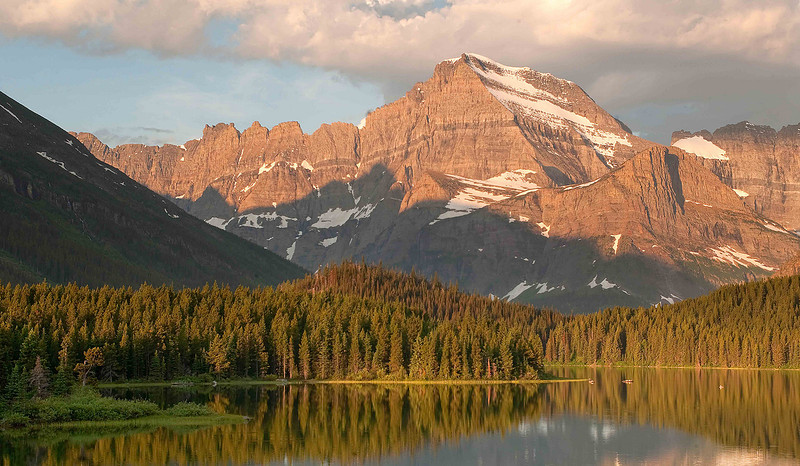
As I was approaching my retirement date I began looking into volunteer opportunities at Glacier National Park. Glacier has been my favorite place to vacation ever since I took a backcountry backpacking trip there with a dear friend in 1988. The restoration of one’s soul that David writes about in Psalm 23 as God leads him beside quiet waters, I found in abundance as God lead me beside both quiet and rushing waters, meadows of wildflowers, forests below rugged peaks that went on seemingly forever and a myriad of wild animals living out their lives nearby. Of course, I’ve found restoration of my soul in many other places as well, not all of them wild, places I also dearly love. And as I travel, I hope and expect to find many more places that are restorative.
Glacier, however, stands out as the healthiest ecosystem I have ever been in. It also doesn’t hurt that it is absolutely gorgeous and situated in the Northern Rockies where summertime temperatures tend to remain tolerable and the air dry. I’m not one for heat and humidity.
But Glacier is not without its challenges, both ecologically and from the standpoint of how we the people manage it. I had received so much from Glacier, retirement looked like a good time to give back and hopefully help with some of those challenges.
Online I read of a variety of Citizen Science programs in need of volunteers. Citizen Science is where average citizens can help researchers collect data for ongoing research projects. In Glacier the organization supporting the Park’s research staff is the Crown of the Continent Research and Learning Institute (CCRLC). Their current Citizen Science projects include performing surveys of Common Loons on lakes within the park, high country surveys of Mountain Goats and Big Horn Sheep, assisting with the late summer/fall Hawk Watch (a count of migrating hawks), and a Native Plant program to propagate and plant out native plants to restore damaged areas.
The Park Service itself also has volunteer opportunities for a variety of programs, like assisting staff at their visitor centers, serving as campground hosts, and backcountry ambassadors, to name just a few. In fact, every year Glacier has over 900 volunteers assisting the operations of the park and research projects. Among all these possibilities I could certainly find ways to contribute.
The Common Loon. Have you ever heard the wail of the Common Loon?1 There’s nothing common about it. It is a song from the heart of where wildness and solitude meet. I first heard it when I was 11. My family was on a canoeing vacation in the Boundary Waters Canoe Area of northern Minnesota and southern Ontario. We had been outfitted for 5 nights on Polaris Lake in Ontario. We would cross into Canada, pulling up to the customs station by canoe, then continue on to the portage for the one mile long, isolated Polaris Lake.
We didn’t know we would share the lake with a family of loons. In her journal my mom recorded that we were serenaded by their calls every day. It impressed her so much, she would recall to us that experience from time to time for years to come. To keep a more present reminder, my parents purchased a beautiful print of a painting by the Canadian artist, Robert Bateman of a loon family on a lake. It hung in their family room until both my parents passed away. Now it belongs to me. I remember the long rising wails of the loons on Polaris Lake and the mournful feeling as it falls back into silence. It is a sound that makes you stop everything to listen, then long to hear it again.
The Common Loon Survey was the first of the Citizen Science projects to get underway. I signed up. In my Travel Blog entry “Lewistown, Montana” you can read why my training was delayed until June 12. Due to my late start the volunteer coordinator said it was too late to take the more advanced training. Big bummer. I’ll have to wait until next year for that. However, this initial training included the requirement to complete at least 3 surveys and file reports using the software provided. I was thankful for the opportunity to do even these few surveys.
During the classroom portion of the training, I learned that one goal of the park’s research is to determine why some lakes with a breeding pair successfully fledge chicks while other lakes with seemingly suitable habitat produce no chicks. Dee, the Volunteer Coordinator on staff with the CCRLC, gave a very helpful presentation on the life history and biology of loons.
One interesting fact is that loons have much heavier bodies than most birds of similar size. Most birds have hollow bones punctuated by internal strut-like structures. This makes them strong, but also light to facilitate flight. Loons however, have heavy bodies largely due to having solid bones that facilitate deep diving. Their legs are set far back on their bodies to make them more effective swimmers underwater. The down side of their weight is it makes them need a long runway to take off. And they must take off from water as they are hopelessly awkward on land.
Dee showed us a video of a loon taking off. It was quite the cliff hanger as we watched it scurry across the surface of the lake, wings flapping, feet pushing against the water, half in, half out, splashing away. On and on it went, each downward flap hitting the water surface. As the loon’s efforts continued I found myself silently egging the loon on toward lift off, "Come on – you can make it!"
After what seemed like a full minute of flapping, the loon was running out of lake. Then, suddenly, the video ended. What? What happened? Did he make it? I felt like we should have been warned that the video was going to end in the middle of the story! It was like watching an Olympian run the 1500m and at the last turn, as they make the final straight away and head for the tape - the network cuts to a commercial break! It was an effective video. We all got it.
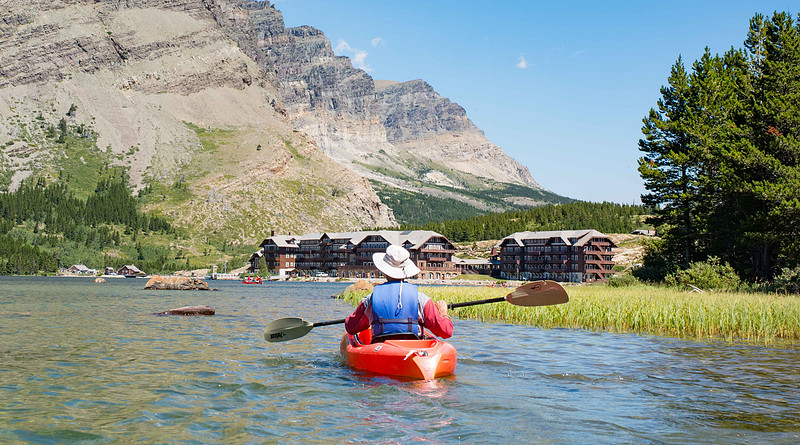
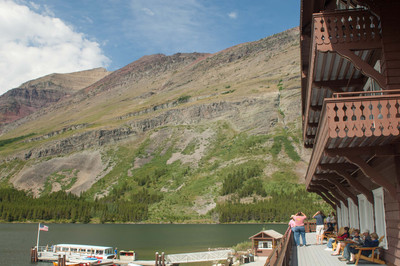
Our training concluded with a field trip to Swiftcurrent Lake in the Many Glacier area. There were about 18 of us in the class. As we gathered along the shoreline by Many Glacier Hotel, Dee and Jami (NPS Loon Biologist) supplied us with several spotting scopes. Loose teams formed to take turns searching the distant shoreline for a loon nest.
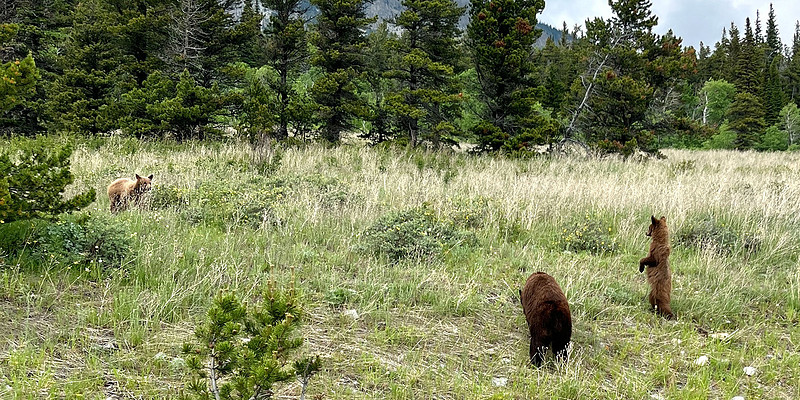
Observations having been made and our training coming to a close, we became like a herd of cats as soon as someone turned their scope on the mountainside off to the north and saw a Black Bear. That mountainside is well known for good wildlife spotting Someone else laid eyes on a Grizzly. And I thought about which lakes I'd like to survey. On the drive back we (my carpool buddies and I) enjoyed watching a momma cinnamon Black Bear grazing peacefully right next to the road while her two cinnamon cubs played nearby. More quiet waters for the soul.
All photos and text are Copyright © Julia Flanagan unless otherwise noted. All rights reserved. Notes: 1. This is a truly beautiful recording. Please enjoy... Voices: Common Loon. YouTube Video. Cornell Lab of Ornithology. https://youtu.be/4ENNzjy8QjU?si=r5ZMFtdMBCq1PrFY
Next Up: A Walk on the Wild Side
Comments
No comments posted.
Loading...
|