Travel Blog: The Idyllic Lake 1
The Idyllic Lake 1: My First Loon Survey
In his 1918 life history of the Common Loon (Gavia immer), Arthur Cleveland Bent wrote, “Among the picturesque lakes of the wilder, wooded portions of the northern States and Canada – where dark firs and spruces mingled with graceful white birches, cast their reflections in the still, clear waters – sportsmen and appreciative nature lovers have found attractive summer resorts. Here, far from the cares of the busy world, one finds true recreation in his pursuit of speckled trout, real rest in his camp among the fragrant balsams, and genuine joy in his communion with nature in her wildest solitudes. The woodland lakes would be solitudes, indeed, did they lack the finishing touch to make the picture complete, the tinge of wildness which adds color to the scene, the weird and mournful cry of the loon, as he calls to his mate or greets some new arrival. Who has ever paddled a canoe, or cast a fly, or pitched a tent in the north woods and has not stopped to listen to this wail of the wilderness? And what would the wilderness be without it?”1
Having completed the initial Loon Citizen Science training on June 12 (See entry Start of Something Loony”), I was indeed hopeful it would lead me to, as Bent put it, “communion with nature in her wildest solitudes”. These surveys, however, are not primarily for communion, but to assist with research that monitors loon breeding success.
Over the last century, the breeding range of common loons in the Lower 48 receded like a melting glacier. Southerly populations declined until breeding populations remained only in the most northerly states. By the mid-1900’s breeding populations had been extirpated from California, Oregon, and Utah in the west, and Iowa, Illinois, Indiana, and Ohio in the mid-west2,3. Loss of habitat, decline in water quality and several other human-related factors were the main causes.
Today, territorial pairs (pairs that form during the breeding season and defend an area of a lake from intruders) appear relatively stable. Montana has the highest number of territorial pairs in the western Lower 48, roughly 72 pairs each year, with Glacier National Park supporting about 20% of those pairs (14 or 15 pairs)4. The average number of eggs that pairs in Glacier hatch each year is only 6. Glacier is over 1 million acres in size and has over 45 lakes with habitat suitable for loons. So, if those sound like very small numbers – they are. It is estimated that across Montana, loons are currently found on only 1% of the lakes that have suitable habitat.
The data I and my fellow citizen scientists would collect could help managers better understand factors influencing the health of breeding populations of this iconic bird in Glacier National Park and beyond. Managers also use the surveys to implement protections designed to help a particular breeding pair succeed. Contributing to these surveys was exactly what I hoped for as a volunteer during my time here. I was eager to get started.
To complete my surveys I was set up with an app to record my data and a link to an online ArcGIS map that was updated regularly with the activity of all the volunteers, indicating which lakes had been surveyed and when, so we could plan our efforts.
I reviewed the list of 45 lakes being surveyed and picked out my first lake. I’ll call it Lake 1 (we were encouraged not to use the actual lake names if we wrote about our surveys in social media to help minimize potential disturbances, especially for lakes with nesting loons or chicks). Some lakes being surveyed were close to roads, accessible by boat, or required only a short hike. Others required extensive hiking on difficult trails and others required overnight backpacking trips. I chose Lake 1 because the hiking required was within my level of conditioning and because I was familiar with the area, having done the hike once several years earlier. Lake 1 was a “Priority 1” lake meaning it had successful nesting in recent years. I was hopeful to see loons with my first survey.
Earlier in the day, before leaving my RV and losing access to cell service, I contacted my group of friends and family who keep track of my travels and let them know my itinerary. Leaving one’s itinerary with someone trusted is a requirement of the loon survey volunteer protocol. I’ve had this arrangement with friends and family ever since I left Northern Virginia, but it felt particularly important today since I knew my survey would require me to leave the trail. And that always adds a little more risk.
I parked in a dirt area across from the trailhead. Before starting up the trail, I took a good look at my topo map. I typically have a good sense of direction and memory of key land features, but it had been 11 years since I was last on this trail. I didn’t want to rely only on memory. I also knew I would need to travel further than I had before and the trail would veer away from Lake 1 before reaching it. I would need to find my own route to a good viewing point. So, I scanned the map, noting what appeared to be the best place to leave the trail.
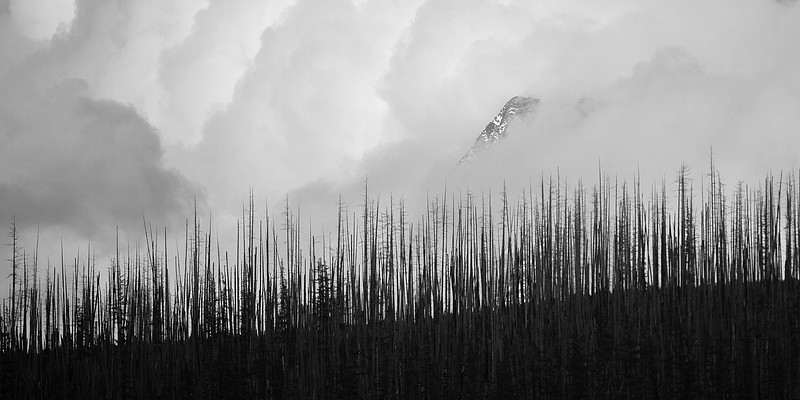
The hike rolled gradually up and over gentle hills. Back in 2014, when I was last here, the area was recovering from a devasting forest fire that scorched the land in 2003. The area burned again in 2018. Regenerating forest of young lodgepole pine and larch lined the trail. I hiked through small patches of unburnt forest revealing the hit and miss intensity of these fires. Most of the burned trees had fallen, but several skeletons remained standing, some blackened others bleached to a pale gray.
I passed only 2 other hikers. The second fellow and I chatted for a bit. Turns out he knew of the loon survey program through his friend who was also doing surveys. She had found a breeding pair on Lake 1 with one chick. Good information. After a little more conversation we parted ways.
Perhaps a half mile later, I reached the point where I thought I should depart from the trail. Standing there I felt a sense of unease.
A flash of memory from my college days came to me just then. Something I hadn’t thought about in a long time. It was of a time when I got lost as I backpacked solo one summer in the Tobacco Root Mountains of Montana, in the Deerlodge National Forest. My second day of hiking was overcast. The trail lead me up through an evergreen forest. Up and up, until I hiked up into low clouds. The trail was not difficult to follow. The trees around me stood as dark shadows. Obscured, but visible. I could still see the path, dirt and rocks distinct from the forest floor. Then the trail opened into a meadow. With no more trees before me it was like hiking directly into a cloud. No markers, only gray.
I stopped. The trail meandered into the mist and disappeared.
I knew not to simply hike into the meadow to find the trail, for if the trail were not evident and I left the forest edge, even going 50’ would mean no landmarks would be visible to give me a sense of direction. I decided to apply a technique I had heard about for situations like this. I made a small circle that encompassed the edge of the forest on either side of me and the meadow. Keeping in sight my known point where the trail emerged from the forest, I successfully made it back to the trail at the forest edge. But I had not found the continuation of the trail. The next part of the technique was to make a slightly larger loop, relying upon the markers one had seen in the first loop to get back to one’s starting point. I started off on the second loop, but something went wrong. Perhaps the cloud had become more dense, perhaps my loop was too big. Whatever the cause, I could not find the forest edge or the trail again. I did not know where I was and I could not see any land marks because of the cloud. This was real trouble.
Looking at my map, I read the topography. It showed a small lake downhill from where the trail entered the meadow. I decided to head downhill. That should get me below the cloud and improve my ability to see the lay of the land. If I could find the lake, I could find the trail which ran along one side of the lake for a short distance.
As I headed downhill, visibility did indeed improve, though all remained overcast and felt very closed in. Dropping below the cloud, I could see the meadow was enormous. I could see the lake below me. And I could see a trail –dozens of them in fact. This was bewildering until I remembered from my work with the Forest Service that summer that they let ranchers take their cattle up into the high mountain meadows for summer grazing. This was the first time I had been in one of those highlands. The cows themselves I could now see widely scattered across the meadow, and a herd of elk too. And I realized I had a new problem. It was impossible to tell the hiking trail from the maze of cattle trails.
Heading downhill, I jumped onto whichever cattle trail led me in the general direction of the lake. On the far side of the lake, I did find a trail wider than most of the others and figured it to be the hiking trail. So, I followed it. But it forked, and narrowed and forked and forked again. I retraced my steps and tried the other trail at the first fork. But it forked and narrowed and forked and forked again. Eventually, I had made so many turns, my mind began to feel as jumbled as the trails themselves.
After about an hour of hiking and repeatedly trying to discern the hiking trail from the numerous cattle trails, I finally came to another lake. It looked completely different than the one I had first encountered. But that made no sense. My map showed the next nearest lake 5 or 6 miles away. I could not have covered that much ground in an hour, could I?
During my increasingly anxious efforts to find the trail, noon had come and gone. My stomach had long been growling at me to stop and eat. A large rock overlooking the lake made for a good lunch spot. As I sat on it, fixing myself a peanut butter and jelly sandwich, I prayed for the Lord to help me know where I was and where I should go. I kept looking at the lake and thinking I simply could not have traveled far enough in that short amount of time to get to the other lake.
Finally, it dawned on me that I had done what I had heard so many do when lost. I had walked in a large circle and had come back to the same lake, only at a different point. It didn’t look familiar because I was looking at it from an entirely different perspective. Now one thing was clear, trying to find the hiking trail among the cattle trails was a waste of time. I consulted my map again. It showed that the stream that flowed out of the lake would cross the hiking trail about a mile below the lake. By then I should be out of this huge meadow and the trail should be more obvious.
After lunch I bushwhacked through thick sage brush that scraped at my legs as I followed the stream down the mountainside and out of the meadow until I did indeed find the trail, clearly distinct from the land around it. It had been roughly 3 hours since I had first realized I was lost. From there on the trail was easy to follow. It continued to run along the stream through forested land. No more meadow, no more cattle trails. Letting out a deep sigh of relief, my hike was now punctuated by talking to God, giving thanks for his care and direction.
That memory of being lost is what brought up a twinge of fear as I stood ready to leave the trail and bushwhack to Lake 1. Fear can be both helpful and debilitating. It can warn you of real danger. But it can also dissuade you from acting reasonably. This was no meadow shrouded in clouds. It was a beautiful clear day. Although weather can change suddenly, I didn’t have far to go, I knew where I was and I had good markers to help me. I acknowledged the helpful part of the fear that made me double check my actions, and recognized I was acting reasonably. I prayed. “Lord, you have kept me safe these many years, keep me now. You know I am not here to test you. Help me safely find the loons, and my way back.”
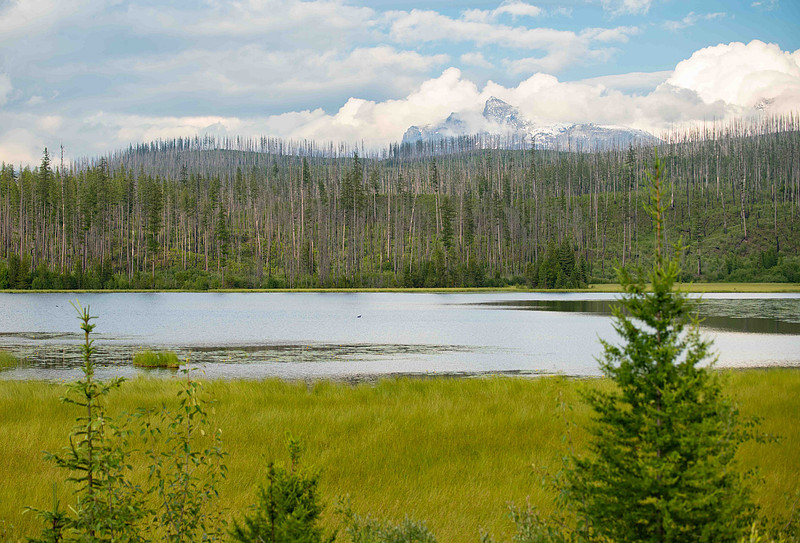
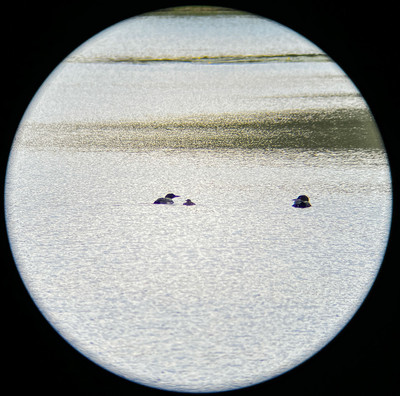
I watched my steps closely as I crossed a small forest opening with several fallen trees, bypassing several holes. Reaching the other side of the forest opening, I pushed through dead lower limbs of pines and larches until I came into a small grassy opening on a hill that overlooked Lake 1. The view was good. I could clearly see roughly 90% of the lake. I was far enough away to avoid any disturbance. I opened the survey app and documented conditions. Setting up my tripod and scope, I began to scan the lake.
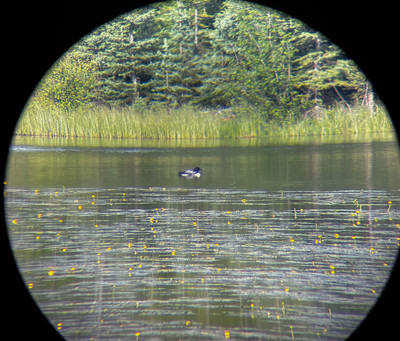
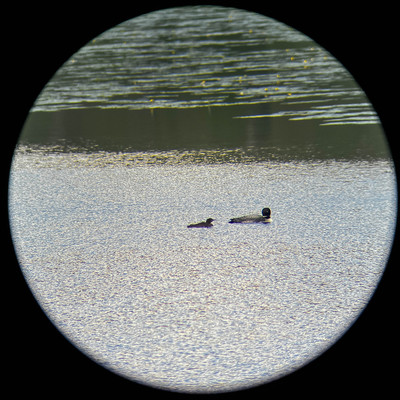
This was my first survey with my new scope and I needed to practice using its features. I zoomed in a little, refocused and scanned again. No chick. I had at least an hour to keep searching. As I repeatedly scanned the lake, the golden-eye appeared to be gradually swimming closer to the 2nd adult, the one diving among the aquatic plants. I watched that adult dive again. It came up with a small fish, swam over to the golden-eye and fed it the fish.
Huh.... Okay. I guess that isn’t a golden-eye. I zoomed in even more, refocused and sure enough – pointy bill, not flat; feathers fluffy downy, not smooth. I checked the app’s pictures of chicks at different ages. It matched a two to three week old chick. This is the chick! Yipee! Note to self – ZOOM IN! Now I could use the rest of my hour to record the data and casually observe their lives in this beautiful, idyllic lake.
Two beaver lodges, one to my right and the other to my left, sat within the marshy edges, separated by a good distance. The beaver’s dam, not far below my viewing spot, yielded the sound of trickling water. Two Canada geese, their heads just visible among the sedges to the right, seemed intent on following the happenings on the lake. Just landward of them, a white-tail doe grazed. Below me a kingbird made sorties over the marsh from his perch near the water’s edge. A male red-winged blackbird called out his presence, “Kon-ga-ree!” At the far side of the lake, the forest was a patchwork of living and fire-killed trees as it ascended a hill. Beyond, snow dusted rocky peaks marked the last sight of land. Huge billowing clouds hugged the peaks. They looked to be illuminated from within as brilliant bands of white to gray expanded into the heavens.
And the quiet...
The quiet brought everything around me together into a unified whole that seeped into my soul and lifted my spirit like a tonic. I felt I was drinking in something that was deeply satisfying, that held within its very existence inexhaustible goodness. Everything was in its place. Every creature living the life it for which it was created. I know even this corner of the world is marred by sin. But right then, the goodness of God, the goodness of his handiwork was palpable. How many are your works, Oh Lord! In wisdom you made them all; the earth is full of your creatures.5
I watched the loon family float across the lake on this gorgeous summer day as though they had not a care in the world. The chick stayed near its parents at times, then ventured away briefly, a sign of its maturing and growing familiarity with life on the lake.
Toward the end of my hour a beaver appeared, swimming in the open water. Suddenly, it slapped its tail loudly against the surface and dove. After it re-appeared, a second beaver slowly approach. I’d read they have poor eyesight. I had always understood a beaver slapping its tail to indicate alarm. These two seemed engaged in a cautious investigation of one another as the second beaver began to circle the first and slowly shrink the circle until they came nose to nose. No fight, no aggression. Family, I thought.
It was after 7:30 PM. My 1 hour of observation time had concluded. I could feel the cool of the evening descending. I still needed to hike out to my truck, so I packed up my gear, deeply satisfied.
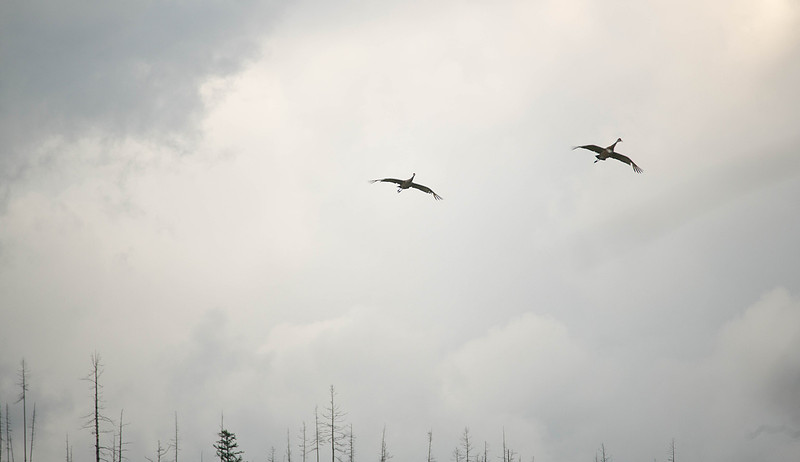
Bushwhacking my way back out was easier than bushwhacking in. I found the trail without any difficulty. With a sense of relief, I gave a prayer of thanks. As I began my hike out, I heard the unmistakable guttural croaking of Sandhill Cranes in the distance, calling over and over in flight. Turning toward the lake, I could see a pair approaching from the mountains just above tree height. With slow wingbeats they followed the curve of the lake until they held their wings steady in descent over the marshy delta. Still announcing their arrival, they dropped down below the tree line and out of sight. They had found their resting place for the night and now it was time for me to find mine.
All photos, videos and text are Copyright ©Julia Flanagan unless otherwise noted. All rights reserved.
Up Next: What is Wisdom?
Keywords:
Citizen Science,
Common Loon,
Gavia immer,
Glacier National Park,
loon,
Loon Survey,
Rocky Mountains
|