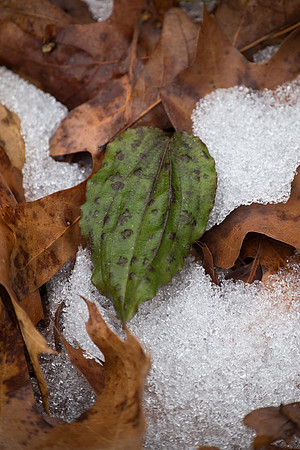
Crane-fly Orchid_J1F5199
There are a variety of strategic adaptations plants have which live under the shade of our great forest canopies, strategies that help them secure the sunlight they need to survive. The Crane-fly Orchid (Tipularia discolor) has been given a unique strategy. Each plant produces a single leaf with skills it deploys in an unusual timing. A plant producing a single leaf is not really so uncommon, but the Crane-fly Orchid's leaf emerges from the forest floor at the cusp of autumn when most plants in the deciduous forest are going into dormancy. All spring and summer long it produced no leaves and has no leaves from a previous year.
This orchid's strategy is to soak up the sunlight reaching the forest floor in winter when all the leaves are off the trees. The big challenge of that strategy? How do you handle freezing temperatures when you are a fragile thin leaf and you must have plenty of water in your cell's cytoplasm for photosynthesis to make energy? You may recall that freezing water expands, making it able to burst cell walls from within. This is what happens to tender leaves with the first frosts of autumn. Freezing water also produces ice crystals that are sharp, able puncture cell walls.
The answer, at least in part, is a pigment. Anthocyanin is a pigment that, for our eyes, produces red, blue, pink and purple colors. Some plants can manufacture it and load it up in their cytoplasm. One of its benefits is that it acts like antifreeze, preventing water from expanding or forming ice crystals in the liquid cytoplasm inside cell walls.
You can see the purple pigment of anthocyanin in the irregularly shaped dots on the upper side of this leaf. The leaf looks predominantly green because the upper leaf cells are also loaded with chlorophyll, a green pigment that dominates over purple. If you were to turn the leaf over you would see it is entirely purple on the underside, where chlorophyll is not produced in quantity. Some varieties of the Crane-fly Orchid are entirely purple top and bottom.
Location: Burke Lake Park, Fairfax County, VA